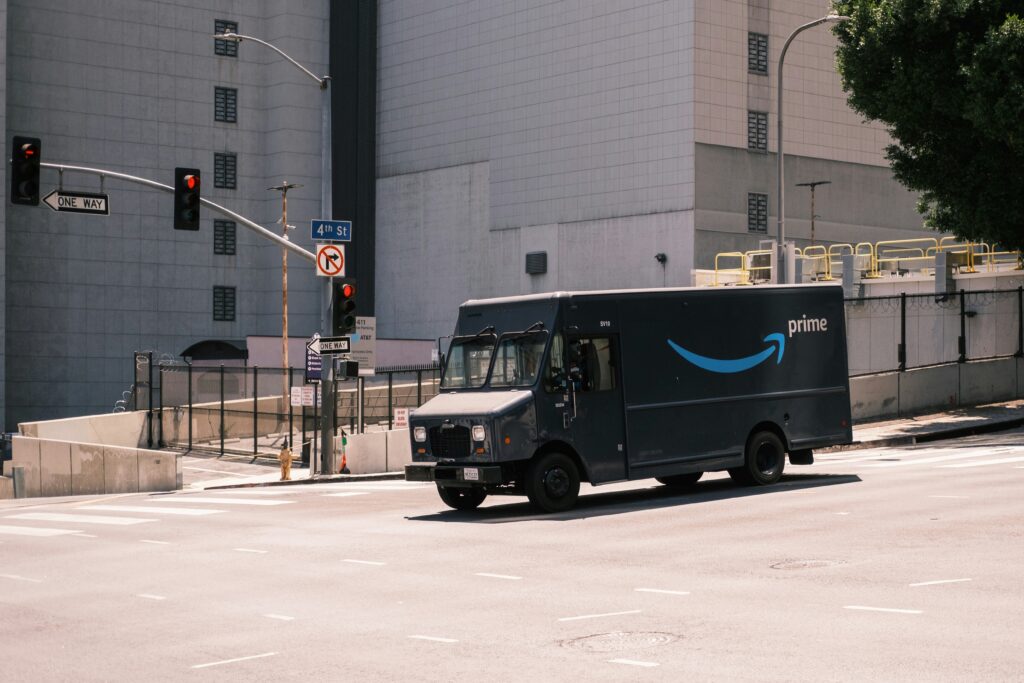
The van that hit you had “Amazon” painted on the side. The driver wore an Amazon uniform. The packages inside were Amazon packages. But when you filed a claim, Amazon’s response was some version of: “That driver doesn’t work for us.”
If you’ve been injured by an Amazon or FedEx Ground delivery vehicle in Nevada, this disconnect between what you saw and what the company claims is not a mistake. It is the result of a deliberate corporate structure designed to put liability at arm’s length. Here is how that structure works, why it does not always hold up, and what legal theories may allow you to reach the company behind the branding.
The Middleman Layer: How DSPs And ISPs Actually Work
Amazon and FedEx Ground do not directly employ most of their delivery drivers. Instead, they use middleman companies that contract with the parent company to handle last-mile delivery. Amazon calls these Delivery Service Partners (DSPs). FedEx Ground calls them Independent Service Providers (ISPs).
Here is what this looks like in practice:
Amazon’s DSP model: A DSP is typically a small LLC employing 20 to 40 drivers. The DSP signs a contract with Amazon Logistics to deliver packages on designated routes. Amazon requires each DSP to carry at least $1,000,000 in commercial auto liability insurance and to list Amazon as an additional insured on the policy. Drivers wear Amazon-branded uniforms, operate Amazon-branded vans (often leased through an Amazon-approved vendor), and follow routes assigned by Amazon’s software. Amazon’s DSP program now includes over 3,000 independently owned companies employing more than 275,000 delivery drivers nationwide.
FedEx Ground’s ISP model: An ISP purchases delivery routes from FedEx Ground, owns or leases its own delivery vehicles, and hires its own drivers. FedEx requires the ISP to maintain commercial auto liability insurance (typically $750,000 to $1,000,000 per occurrence). Vehicles carry FedEx branding and drivers wear FedEx uniforms. ISP vehicles operate under FedEx Ground’s U.S. DOT number and Motor Carrier number.
In both models, the contract between the parent company and the DSP/ISP says the same thing: the DSP or ISP is an “independent contractor,” not an employee, and the parent company is not liable for the contractor’s negligence.
That is the shield. Here is how courts have been piercing it.
Why The “Independent Contractor” Defense Is Weakening
The independent contractor label is a starting point for legal analysis, not an ending point. Nevada courts, like courts across the country, look beyond what a contract says and examine how the relationship actually operates. The central question is control: does the parent company control not just the result of the work, but the means and manner of how the work is performed?
Juries are increasingly answering “yes.” In December 2023, a South Carolina jury returned a $44.6 million verdict (including $30 million in punitive damages) against Amazon after a DSP driver on an active delivery route turned into the path of a motorcyclist. The jury in Shaw v. Amazon.com, Inc. found that Amazon was vicariously liable for the DSP and its driver, and that Amazon was grossly negligent in its hiring, supervision, and retention of the driver — despite Amazon’s argument that the DSP was an independent contractor. It was the first jury verdict in the country holding Amazon liable for a DSP driver’s negligence. In August 2024, a Georgia jury reached a similar conclusion in Bradfield v. Amazon Logistics, awarding $16.2 million after an Amazon delivery van struck and severely injured a child. The jury assigned 85% of responsibility to Amazon on a negligent training claim and found that Amazon exercised sufficient control over the DSP to be liable as the driver’s employer.
These verdicts are not Nevada cases, and every case depends on its own facts and circumstances. But they illustrate a national trend that Nevada courts may find persuasive: the independent contractor label does not automatically shield the parent company when the evidence shows employer-level control.
The Right-To-Control Test
Under Nevada law, the key factor in determining whether a worker is an employee or independent contractor for liability purposes is the degree of control the hiring entity exercises over the worker. Courts examine whether the worker is “under the control of” the entity and acting within the scope of duties the entity defined.
With Amazon DSP drivers, evidence of control is extensive:
Route assignment: Amazon’s proprietary software assigns every package and every stop. DSP drivers do not choose their own routes, sequence their own deliveries, or decide which packages to deliver first. Amazon’s system dictates the order.
Real-time monitoring: Amazon uses in-cab camera systems (Netradyne) and a driver-scoring app (Mentor) to track speed, hard braking, cornering, following distance, and distracted driving on every shift. Drivers receive performance scores that directly affect the DSP’s contract standing with Amazon.
Hiring and training standards: DSPs must follow Amazon’s hiring criteria, including specific background check requirements. Once hired, every driver completes Amazon’s training program on safe driving practices and delivery policies.
Appearance and branding: Amazon financially incentivizes DSPs to become “Amazon-branded.” Branded DSPs earn more per delivery but must purchase Amazon uniforms and lease Amazon-branded vehicles through Amazon-designated vendors.
Delivery quotas and pace: Amazon sets delivery expectations, including 350 to 400 packages per vehicle per day and expected completion times. Multiple lawsuits have alleged that Amazon’s delivery pace requirements create pressure that contributes to unsafe driving. A CBS News analysis of six years of federal safety data found that Amazon’s contracted carriers had unsafe driving violation rates — including speeding and texting while driving — at least 89% higher than non-Amazon carriers in every month examined.
FedEx Ground exercises similar control over ISP drivers through handheld scanners that track location and delivery times, required FedEx branding on vehicles and uniforms, and vehicle maintenance and appearance standards.
When the company dictating routes, monitoring driving behavior, setting hiring standards, controlling branding, and establishing delivery pace claims it has no control over the driver, courts are increasingly skeptical.
Ostensible (Apparent) Agency
Nevada recognizes the doctrine of ostensible agency. The Nevada Supreme Court addressed the doctrine in Schlotfeldt v. Charter Hospital of Las Vegas, 112 Nev. 42 (1996), and later affirmed its application in Renown Health v. Vanderford, 126 Nev. 221 (2010), establishing the factors courts examine: whether the injured party looked to the institution rather than the individual, whether the institution selected the person who caused the harm, and whether the injured party had no reason to believe the person was not acting on the institution’s behalf.
The core principle: if a company presents someone to the public as its agent, and a reasonable person would believe that person is acting on the company’s behalf, the company can be held liable for the agent’s negligence, regardless of the actual contractual relationship.
With Amazon and FedEx delivery vehicles, the ostensible agency argument is strong. The van carries the company’s logo. The driver wears the company’s uniform. The packages inside bear the company’s branding. The tracking notification on your phone says “Your Amazon package is being delivered.” A reasonable person standing on the sidewalk when that van runs a red light would have every reason to believe the driver works for Amazon or FedEx. The companies created that appearance deliberately because it benefits their brand. They should not be allowed to disclaim the relationship only when liability attaches.
Negligent Hiring, Supervision, And Retention
Even if a court accepts the independent contractor classification, a separate theory may apply: the parent company can be held directly liable for its own negligence in selecting, supervising, or retaining the contractor. If Amazon contracted with a DSP that had a pattern of hiring drivers with dangerous driving histories, or if FedEx Ground continued operating with an ISP it knew was violating safety requirements, the parent company’s own failure to exercise reasonable care becomes the basis for liability.
This theory does not require proving that the driver was an employee. It requires proving that the parent company knew, or should have known, that the contractor or its drivers posed a risk, and failed to act. In the Bradfield case described above, the Georgia jury specifically found Amazon liable on a negligent training theory, separate from the vicarious liability finding.
The Insurance Problem: Why The DSP’s Policy May Not Be Enough
Both Amazon DSPs and FedEx Ground ISPs are required to carry commercial auto liability insurance, typically $1,000,000 per occurrence. For many accidents, this coverage is sufficient. But for serious injuries (traumatic brain injuries, spinal cord damage, multiple surgeries, long-term rehabilitation), $1,000,000 can be inadequate, especially when multiple parties are injured in the same accident.
This is precisely why piercing the independent contractor shield matters. If you can only reach the DSP’s or ISP’s insurance, you are limited to whatever coverage that small company carries. If you can establish that Amazon or FedEx is also liable, whether through the control test, ostensible agency, or negligent hiring, you may access the parent company’s corporate insurance, which represents a significantly deeper pool of coverage.
Nevada’s Independent Contractor Framework
Nevada’s test for independent contractor status under NRS 608.0155 examines factors including whether the worker controls the means and manner of the work, controls when the work is performed, can work for other companies, and can hire employees to assist. A worker meeting at least three of these criteria may be presumed an independent contractor for wage and hour purposes.
However, this statutory test applies specifically to claims under NRS Chapter 608 (wages and employment). For tort liability (personal injury claims), Nevada courts apply the common-law right-to-control analysis, which focuses on whether the hiring entity controlled the manner and method of the work. The distinction matters: a DSP may technically qualify as an independent contractor under the statutory test because it holds a business license and employs its own workers, while simultaneously failing the common-law control test because Amazon dictates virtually every aspect of how those workers perform their jobs.
Nevada’s comparative negligence rule (NRS 41.141) also applies. If you are found more than 50% at fault for the accident, you recover nothing. Even partial fault reduces your recovery proportionally. In multi-party delivery vehicle accidents, fault can be allocated among the driver, the DSP/ISP, the parent company, and potentially other drivers involved in the collision.
When Your Case Is Likely Strong Vs. Likely Weak
Indicators of a stronger claim:
- The van was clearly branded (Amazon logo, FedEx Ground markings), supporting an ostensible agency argument
- The driver was on an active delivery route at the time of the accident (not commuting, not on a personal errand)
- Your injuries are serious enough that the DSP’s/ISP’s $1,000,000 policy is insufficient, creating a need to reach the parent company
- Evidence exists that Amazon or FedEx exercised significant operational control over the driver (route data, monitoring records, performance scores)
- The DSP/ISP or driver had prior safety issues the parent company knew or should have known about
Indicators your claim may face challenges:
- The vehicle was unbranded or the driver was off-route at the time of the accident, weakening the ostensible agency theory
- Your injuries are within the DSP’s/ISP’s policy limits, in which case piercing the contractor shield may not be necessary to achieve full recovery
- Fault is disputed or shared, and the insurer is attempting to assign you a significant percentage of responsibility
- The driver was an Amazon Flex driver (personal vehicle, no branding), where the control analysis is weaker than with DSP drivers
A note on Amazon Flex: Amazon Flex drivers use their own personal vehicles to deliver packages through an app-based gig model, similar to rideshare driving. They do not drive branded vans or wear Amazon uniforms. Because they use personal vehicles, insurance coverage can be more complicated — their personal auto policy may deny coverage for commercial activity, and Amazon’s contingent coverage during active delivery blocks may be the primary source of recovery. If you were hit by an Amazon Flex driver, the legal and insurance analysis differs significantly from a branded DSP van accident.
What To Do If You Were Hit By A Branded Delivery Van
Document the branding immediately. Photograph the vehicle from multiple angles, capturing the logo, license plate, and any fleet identification numbers. Photograph the driver’s uniform if it bears company branding. This evidence supports both your identification of which parties are responsible and your ostensible agency argument.
Get the police report. Make sure the responding officer documents the driver’s employer information, the company name on the vehicle, and any fleet or route numbers. If the driver claims to work for a company you have never heard of (the DSP or ISP), note that name separately from the branding on the van. Both matter.
Do not accept the first settlement offer from the DSP’s insurer. The DSP’s or ISP’s insurance company will likely contact you quickly with an offer designed to resolve the claim before anyone investigates whether the parent company is also liable. Accepting that offer may waive your right to pursue Amazon or FedEx separately.
Preserve evidence of the delivery route. If the driver was delivering packages in your neighborhood, that delivery activity is relevant to proving the driver was acting within the scope of work. Note any packages visible in the van, any delivery confirmations you or neighbors received around the time of the accident, and any tracking notifications.
Watch The Clock
Nevada requires personal injury claims to be filed within two years of the accident (NRS 11.190). Cases involving corporate contractor structures take longer to investigate than standard car accident claims because identifying all liable parties, obtaining the DSP/ISP contract with the parent company, and developing evidence of control all require time. Starting early matters.
Talk To Jack About Your Situation
Piercing the independent contractor shield requires understanding how Amazon and FedEx structure their delivery operations, what legal theories apply under Nevada law, and how to develop the evidence of control that makes the parent company a proper defendant. With 40+ years as a personal injury attorney, Jack Bernstein knows how to identify every liable party in a delivery vehicle accident and pursue recovery beyond the contractor’s policy limits when the facts support it. Contact Jack Bernstein Injury Lawyers for a free consultation: (702) 633-3333.