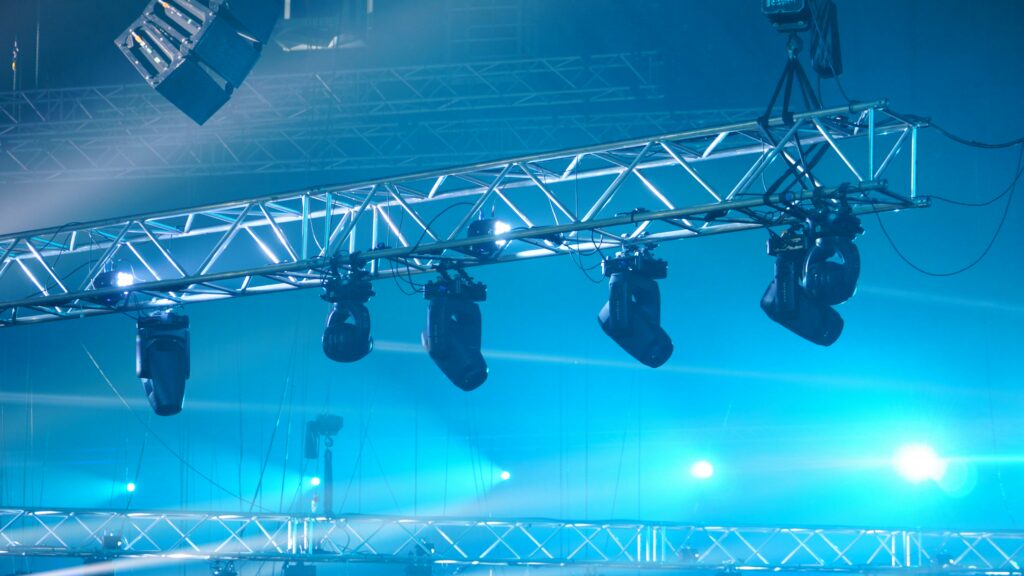
If a light, speaker, LED panel, or truss component fell from overhead rigging and injured you at a Las Vegas event, concert, convention, or show, you likely have a strong legal claim. Properly rigged equipment does not fall. The fact that it fell is itself evidence that someone was negligent. Nevada law recognizes this principle through a legal doctrine called res ipsa loquitur (Latin for “the thing speaks for itself”), and it fundamentally changes how these cases work in your favor.
Whether you were a crew member working the load-in, an attendee watching the show, or a vendor setting up a booth underneath an active rigging grid, this guide explains who may be liable, how to pursue a claim, and why rigging drop cases are often stronger than other types of event injury claims.
Why “The Thing Speaks for Itself” Matters for Your Case
In most personal injury cases, the injured person has to prove exactly what the defendant did wrong. You have to identify the specific negligent act, connect it to your injury, and prove it with evidence. That can be difficult when you are standing below a rigging grid and something falls on you, because you have no way of knowing whether the failure was a defective shackle, an overloaded motor hoist, a missed inspection, or an improperly secured truss pin.
Res ipsa loquitur eliminates that burden in situations where the injury itself implies negligence. The Nevada Supreme Court established the framework for res ipsa in Otis Elevator Co. v. Reid, 101 Nev. 515, 706 P.2d 1378 (1985), holding that an inference of negligence is permitted when three elements are met:
- The event is the kind that ordinarily does not occur in the absence of someone’s negligence. Lights and speakers do not fall from properly installed truss systems during normal event operations. A rigging failure during a concert is not a foreseeable “accident.” It is a failure of the safety systems designed to prevent exactly this outcome.
- The instrumentality was in the exclusive control of the defendant. The overhead rigging system, including the truss, chain motors, shackles, safety cables, and all associated hardware, is designed, installed, inspected, and maintained by the rigging contractor and the production team. An attendee or ground-level crew member has no access to or control over the overhead grid.
- The event was not due to any voluntary action or contribution on the part of the plaintiff. If you were standing in an authorized area (whether as an audience member, a crew member at your assigned position, or a vendor in your booth), you did nothing to cause a rigging component to fall from above.
Under Nevada Jury Instruction 4.19, when these elements are satisfied, a jury may infer that the accident was caused by the defendant’s negligence. This does not guarantee a verdict, but it shifts the practical burden: the defendant must now explain how the equipment fell without anyone being negligent. In a rigging drop case, that is an extremely difficult explanation to provide.
The Nevada Supreme Court applied similar reasoning in Judson v. Camelot Food, Inc. (1988), where a restaurant seat collapsed under a patron. The court held that the restaurant was in a better position than the customer to explain why the seat failed, and the patron was entitled to rely on res ipsa. The same logic applies with even greater force when heavy entertainment equipment falls from overhead: the entities that designed, installed, and inspected that rigging system are in exclusive control of it, and they are in the best position to explain why it failed.
Two Separate Legal Tracks: Negligence and Product Liability
Rigging drop cases often involve two independent legal theories, and you may be able to pursue both simultaneously.
Track 1: Negligence (Someone Made a Mistake)
This is the claim that someone in the production chain failed to exercise reasonable care. The rigging contractor did not properly inspect the hardware. The production manager overloaded the truss beyond its rated capacity. The venue failed to verify that the rigging plan was engineered for the load. The chain motor operator did not follow proper procedures.
Negligence claims are governed by standard personal injury principles. In Nevada, you must prove duty, breach, causation, and damages. Res ipsa loquitur, as described above, helps you establish the breach element even when you cannot identify the specific failure.
Nevada’s comparative negligence rule (NRS 41.141) applies: if you were partially at fault, your recovery is reduced by your percentage of fault. If your fault exceeds 50%, you recover nothing. In a rigging drop case where the plaintiff was on the ground in an authorized area, establishing plaintiff fault is difficult for the defense.
Track 2: Strict Product Liability (The Equipment Was Defective)
If the failure was caused by a defective component (a shackle that cracked, a chain hoist with a faulty brake, a truss coupling pin that sheared under rated load), you may have a strict product liability claim under Nevada law.
Nevada adopted strict product liability through case law, beginning with Shoshone Coca-Cola Bottling Co. v. Dolinski, 82 Nev. 439, 420 P.2d 855 (1966), and extended the doctrine to all product types in Ginnis v. Mapes Hotel Corp., 86 Nev. 408, 470 P.2d 135 (1970). Under this doctrine, a manufacturer, distributor, or seller of a defective product is liable for injuries caused by the defect, even if they exercised reasonable care. The scope of product liability is defined in NRS 695E.090. You do not need to prove negligence. You need to prove three things:
- The product was defective (manufacturing defect, design defect, or inadequate warnings)
- The defect made the product unreasonably dangerous
- The defect caused your injury
This is significant in rigging cases because many components (chain motors, shackles, carabiners, truss sections, wire rope) are manufactured by specialized companies and distributed through rental houses. If a chain hoist brake fails because of a manufacturing defect, both the manufacturer and the rental company that supplied it may be strictly liable, regardless of whether the rigging contractor properly inspected it.
The practical difference: in a negligence claim, you sue the people who installed and operated the rigging. In a product liability claim, you sue the companies that made and supplied the hardware. In many rigging drop cases, both theories apply, and pursuing both increases the pool of potentially liable defendants.
Who Is in the Liability Chain
Event rigging involves a multi-party contractor chain similar to what we described in our article on scaffolding collapses at event sites. The key parties include:
Venue owner or operator. The arena, convention center, or outdoor site controls the premises and sets safety requirements. The venue often provides the permanent rigging points (ceiling steel, beam clamps, motor positions) to which the production’s rigging attaches. If the venue’s structural rigging points were inadequate, overloaded, or improperly rated, the venue may be liable.
Event promoter or production company. The entity that contracted for the production and selected the rigging contractor. Under OSHA’s multi-employer citation policy (CPL 02-00-124), the production company may be a “controlling employer” with a duty to exercise reasonable care to prevent and detect safety violations by its subcontractors.
Rigging contractor. The company that designed the rigging plan, selected the hardware, and installed the overhead system. This is typically the “creating employer” under OSHA’s framework. They bear the most direct responsibility for the safety of the overhead system.
Equipment rental company. Many touring productions rent chain motors, truss, and rigging hardware from specialized rental houses. If defective equipment was supplied, the rental company may be liable under both negligence (failure to inspect before renting) and strict product liability (supplying a defective product).
Equipment manufacturer. The company that manufactured the truss, chain hoist, shackle, or other component that failed. Strict product liability applies.
Important: Nevada is a State Plan state, meaning OSHA standards are enforced by the Nevada Occupational Safety and Health Administration (Nevada OSHA), which operates under the Division of Industrial Relations, Department of Business and Industry. After a rigging failure, Nevada OSHA investigates and may issue citations. Those inspection reports are discoverable evidence that can significantly strengthen your case.
Crew Member Versus Attendee: Different Legal Paths
Your legal options differ significantly depending on whether you were working the event or attending it.
If you were an attendee, vendor, or bystander: You have the most straightforward path. No workers’ compensation barrier applies. You can file a personal injury claim against any negligent party in the chain (venue, promoter, rigging contractor, equipment supplier, manufacturer). Res ipsa loquitur applies powerfully in your favor, because you had zero control over or access to the overhead rigging system.
If you were a crew member: The workers’ compensation framework applies. Under Nevada law (NRS 616A.020), workers’ comp is generally the exclusive remedy against your own employer. But you can pursue third-party claims against other entities in the chain that are not your employer. We cover the workers’ comp versus third-party analysis in detail in our scaffolding collapse article, including how employment classification (W-2 versus 1099 versus union dispatch through IATSE Local 720) determines your options. The same framework applies to rigging injuries.
One important distinction for crew members: even though workers’ comp limits your claims against your own employer, a product liability claim against the equipment manufacturer or rental company is not barred by workers’ comp. Product liability is a separate legal track. If a defective chain hoist caused the drop, you can pursue the manufacturer regardless of your employment status.
What Compensation May Be Available
The types and amount of compensation depend on whether you were an attendee or a crew member, and which legal tracks apply to your case.
For attendees, vendors, and bystanders (personal injury claim): You can pursue the full range of damages, which may include medical expenses (emergency treatment, surgery, hospitalization, rehabilitation, and ongoing care), lost wages and earning capacity, pain and suffering, emotional distress (including PTSD and anxiety from the incident), and loss of enjoyment of life.
For crew members with only a workers’ comp claim: Workers’ compensation covers medical expenses and a portion of lost wages (typically two-thirds of your average monthly wage, subject to caps). It does not cover pain and suffering, emotional distress, loss of enjoyment of life, or full lost earning capacity.
For crew members with a third-party claim: If you can pursue a third-party personal injury claim against a party other than your employer (such as the venue, promoter, equipment manufacturer, or rental company), you can recover the full range of damages including pain and suffering and emotional distress. In a serious rigging injury involving spinal damage, traumatic brain injury, or crush injuries, the difference between workers’ comp alone and a third-party claim can be hundreds of thousands of dollars.
Product liability claims (available to both crew and attendees): If the cause was a defective component, damages may also include compensation for permanent disability, disfigurement, and future medical needs related to the defect.
Rigging-Specific Safety Standards That Strengthen Your Case
Violations of applicable safety standards serve as evidence of negligence. In event rigging cases, the relevant standards include:
Federal OSHA standards. 29 CFR 1926.251 requires that all rigging equipment for material handling be inspected prior to use on each shift, that defective rigging be removed from service, and that all rigging hardware have legible identification markings showing the manufacturer’s rated safe working load. Rigging equipment must not be loaded beyond its rated capacity. 29 CFR 1926.1425 prohibits any employee from being positioned directly under a suspended load.
ANSI/ESTA entertainment industry standards. The Entertainment Services and Technology Association (ESTA) publishes ANSI-accredited standards specifically for entertainment rigging:
- ANSI E1.2 covers the design, manufacture, and use of aluminum trusses, towers, and associated structural components used in portable entertainment structures.
- ANSI E1.6-1 covers powered hoist systems used in entertainment, including requirements for chain hoists, load ratings, inspection protocols, and safety factors (a 5:1 safety factor is standard for critical rigging components).
- ANSI E1.8 covers loudspeaker enclosures intended for overhead suspension, including working load limits and structural requirements for suspension hardware.
- ANSI E1.47 provides guidelines for entertainment rigging system inspections, including inspection frequency, inspector qualifications, and documentation requirements.
- ANSI ES1.18 covers event safety rigging specifically, including requirements for rigging plans, load calculations, competent rigging personnel, and fall protection.
These ANSI standards are not legally mandatory in the way OSHA regulations are. However, they represent the recognized standard of care in the entertainment rigging industry. A rigging contractor who deviates from these standards without justification is vulnerable to a negligence argument that they failed to meet the industry standard of care.
Nevada-specific requirements. Nevada mandates OSHA safety training specifically for entertainment industry workers (NRS 618.9901 through 618.9913). Workers must hold a current OSHA-10 completion card within 15 days of hire. Supervisory employees must hold an OSHA-30 card. If the rigging crew lacked current training certifications, that is evidence of negligence by the employer.
What Evidence to Preserve Immediately
Rigging systems are temporary. After the show, the rig comes down, the equipment goes back in road cases, and the production moves to the next city. If you do not act quickly, the physical evidence disappears.
Critical documents to request:
- Rigging plot. The engineered drawing showing every motor position, load point, and weight calculation for the overhead system. If the actual rig deviated from the plot, that deviation is evidence.
- Load calculation sheet. The document showing the total weight on each rigging point versus the rated capacity of the hardware at that point. Overloading is a common cause of rigging failures.
- Equipment inspection logs. OSHA requires rigging equipment be inspected before each shift (29 CFR 1926.251). ANSI E1.6-1 requires maintenance and inspection records for chain hoists. These logs (or their absence) are critical.
- Chain motor certification records. Chain hoists have rated capacities and require periodic inspection and load testing. Expired certifications suggest the equipment was not properly maintained.
- Serial numbers of failed hardware. Shackles, carabiners, chain motors, and truss sections all have serial numbers that trace back to the manufacturer, the rental house, and the inspection history.
- Daily production report and call sheet. These establish who was on-site, what companies they worked for, and what tasks they were performing.
- OSHA training card records. Under Nevada law, employers must verify workers hold current OSHA-10/OSHA-30 cards.
Immediate steps:
- Photograph the failed equipment and the surrounding area before anything is moved
- If possible, ensure the failed component is preserved (not thrown away or packed into a road case and shipped out)
- Send a written preservation demand (spoliation letter) to the venue, production company, and rigging contractor, requiring them to preserve all physical evidence, documents, and electronic records related to the rigging system
- Get medical attention and document your injuries
When Your Case May Be Strong Versus Weak
Strong claim indicators:
- Equipment fell during normal operations (not during a rigging crew actively building or dismantling the rig, which involves different risk assumptions)
- No inspection logs exist, or logs show the last inspection was conducted months or years before the event
- The rigging plan was not prepared or reviewed by a qualified engineer or registered design professional
- The equipment that failed had expired certifications, visible wear, or was used beyond its rated working load limit
- The rigging contractor did not hold current OSHA training cards as required by Nevada law
- You were in an authorized area with no way to know about or avoid the hazard overhead
Weaker claim indicators:
- You were in a restricted area clearly marked as a “hard hat zone” or “loading hazard zone” and chose not to wear required personal protective equipment
- The equipment failure resulted from an unforeseeable external event (seismic activity, structural failure of the building itself unrelated to the rigging load)
- You were a rigging crew member who personally installed or inspected the hardware that failed and signed off on its condition
These are illustrative factors, not outcome predictions. Every case depends on its specific facts, evidence, and circumstances. Contact an attorney for evaluation of your situation.
Watch the Clock: Filing Deadlines
Nevada’s statute of limitations for personal injury claims is two years from the date of injury (NRS 11.190). For workers’ compensation, you must provide written notice to your employer within 7 days of the accident. Both deadlines run independently. Filing one does not preserve the other.
Product liability claims also carry a two-year statute of limitations. If your claim involves both a negligence theory and a product liability theory, both must be filed within the two-year window.
Frequently Asked Questions
What if the venue says the production company is responsible, and the production company says the rigger is responsible?
This finger-pointing is common in multi-party cases and actually works in your favor. Under Nevada’s comparative negligence framework (NRS 41.141), you can name all potentially responsible parties as defendants. The jury assigns a percentage of fault to each. You do not have to choose between them. Let them argue among themselves about who bears the greater share of fault. Your job is to prove that the equipment fell and that you were injured. Res ipsa loquitur does the heavy lifting on the negligence question.
Can I still sue if the event was weeks ago and the rigging has been taken down?
Yes. The two-year statute of limitations gives you time. However, physical evidence becomes harder to obtain once the rig is dismantled. The sooner you send a written preservation demand, the stronger your position if evidence has been destroyed. Destruction of evidence after a party knows about a potential claim can itself create legal consequences (adverse inference instructions).
What if I was not physically hit but suffered hearing damage or psychological injury from a near-miss?
Nevada law allows recovery for emotional distress and other non-physical injuries in certain circumstances. If a heavy speaker array crashed to the ground feet away from you, the psychological impact of that near-miss can be compensable, particularly if you can document resulting anxiety, PTSD symptoms, or other conditions through medical or psychological evaluation. The strength of these claims depends on documentation and the specific facts.
What to Do Next
- Get medical attention immediately and document all injuries
- Report the incident in writing to your employer (if you are a worker) and to the venue
- Photograph the scene, the failed equipment, and the overhead rigging before teardown begins
- Identify every company involved: venue, promoter, production company, rigging contractor, equipment rental company
- Send a written preservation demand to all parties before evidence is removed from the site
- Do not sign any release or accept any settlement offer before consulting an attorney
Rigging drop cases involve a unique intersection of construction safety law, product liability, and entertainment industry standards. With 40+ years as a personal injury attorney, Jack Bernstein understands how these overlapping legal frameworks apply to Las Vegas event injuries. If you or someone you know was injured by falling equipment at a concert, convention, or event, contact Jack Bernstein Injury Lawyers for a free consultation: (702) 633-3333.