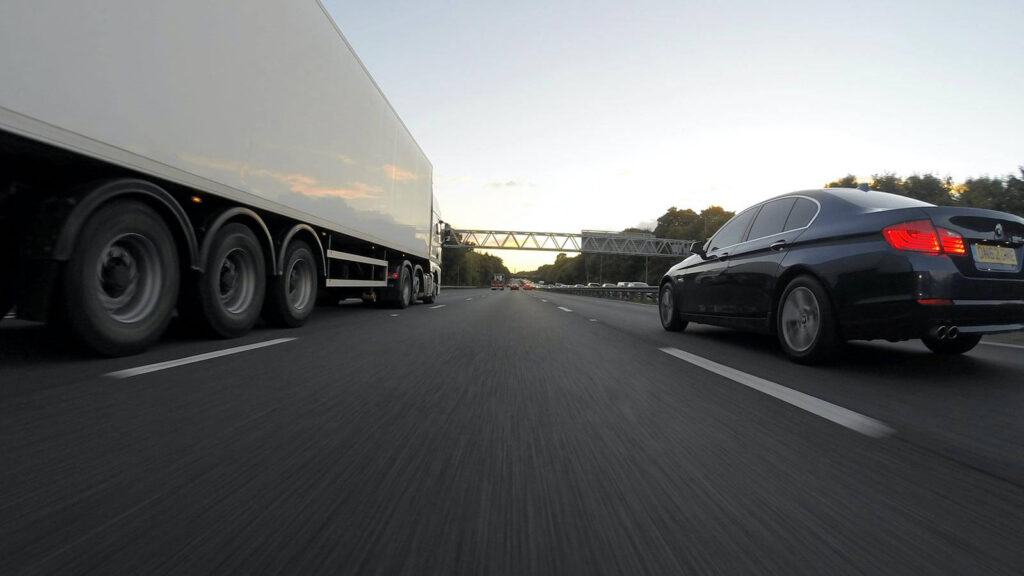
If a truck merged or changed lanes into your vehicle and the driver told police “I didn’t see them,” that statement may feel like an excuse. It is not. For a commercially licensed truck driver, “I couldn’t see you” is an admission that they failed to perform a procedure they were specifically trained, tested, and federally required to execute before every lane change.
The trucking industry and its insurers have spent decades promoting the “No-Zone” concept, originally an FMCSA public safety campaign designed to help passenger vehicle drivers avoid dangerous positions around large trucks. But insurance adjusters have repurposed the No-Zone as a blame-shifting tool: “You were in the truck’s blind spot, so you share responsibility for the crash.”
If you’ve been injured in a blind spot collision with a commercial truck in Nevada or on a nearby highway, whether a lane-change sideswipe, a merge collision, or a right-turn squeeze, understanding this distinction can determine whether you recover full compensation or get pushed past Nevada’s 50% comparative negligence bar and recover nothing.
The No-Zone Was Never Meant To Be A Legal Defense
The FMCSA introduced the No-Zone campaign in 1994 to educate the general public about staying visible around large trucks. The campaign identifies four blind spot areas: the front, rear, left side, and right side of a commercial vehicle.
Here is what the campaign does not say: that being in a truck’s blind spot makes the crash your fault.
The FMCSA’s own driver training materials on inadequate surveillance place the responsibility squarely on the truck driver:
- Check mirrors every 5 to 8 seconds and before every lane change, turn, or merge
- Scan the road ahead at least 15 seconds in front of the vehicle
- Be vigilant in watching for vehicles in the No-Zone because other drivers “probably don’t realize” how large truck blind spots are
The FMCSA is telling commercial drivers: you know other vehicles will end up in your blind spots. That is the normal condition of highway driving. Your job is to manage it.
What CDL Holders Are Trained To Do Before Changing Lanes
A Commercial Driver’s License (CDL) is not a regular driver’s license. It requires specific training on vehicle operation, including blind spot management. The FMCSA’s Entry-Level Driver Training (ELDT) rule mandates classroom and behind-the-wheel instruction before a driver can obtain a CDL.
Standard CDL lane-change protocol requires a specific sequence:
- Signal intent well before beginning the maneuver
- Check all mirrors (flat mirrors, convex mirrors, hood-mounted spot mirrors)
- Recheck the blind spot on the side of the intended lane change
- Pause briefly to allow time for a vehicle that may have entered the blind spot since the last mirror check
- Begin the lane change gradually, continuing to monitor mirrors throughout
When a truck driver says “I didn’t see the car,” the question becomes: which step did they skip? Did they check their mirrors at all? Did they signal? Did they pause? Did they recheck? Each omitted step is a failure to follow training that was a condition of their commercial license.
Federal Mirror Requirements Exist For This Reason
Federal regulations require specific mirror equipment on commercial vehicles. Under 49 CFR § 393.80, every truck and truck tractor must have two rear-vision mirrors, one on each side, positioned to give the driver a view of the highway to the rear along both sides of the vehicle. These mirrors must meet the standards set by FMVSS No. 111.
Many modern commercial trucks also come equipped with:
- Convex (wide-angle) mirrors that reduce blind spot size
- Hood-mounted spot mirrors for the front blind spot and right-side danger zone
- Blind spot detection systems that alert the driver when a vehicle is in an adjacent lane
- Lane departure warning systems and collision mitigation technology
Each of these is a potential evidence point. If the truck was equipped with blind spot detection and the driver ignored the alert, that is evidence of negligence. If the truck should have had functioning convex mirrors but they were broken, cracked, or improperly adjusted, that is a maintenance violation with direct relevance to the crash. If the trucking company failed to maintain required safety equipment, that creates independent liability for the company beyond the driver’s individual negligence.
The Data On Surveillance Failures
The FMCSA’s Large Truck Crash Causation Study (LTCCS), the most comprehensive federal study of truck crash causes, found that inadequate surveillance was an associated factor in 14% of serious truck crashes, representing an estimated 20,000 trucks during the study period. Trucks with inadequate surveillance were 9.3 times more likely to be assigned critical crash responsibility; the highest relative risk of any driver-related factor in the study.
To put that 9.3x figure in context, the same study’s associated factors table shows that fatigue carried an 8.0x relative risk, external distraction 5.1x, internal distraction 5.8x, and traveling too fast for conditions 7.7x. Not checking your blind spots before changing lanes is, by the federal government’s own data, the single most dangerous driver behavior a trucker can engage in. And it is the behavior insurance companies want to blame you for.
How The Insurance Company Uses The No-Zone Against You
When a trucking company’s insurer investigates a blind spot collision, the adjuster has one primary objective in Nevada: assign you enough fault to cross the 51% threshold under Nevada’s modified comparative negligence rule (NRS 41.141). If they succeed, you recover nothing, regardless of your injuries.
The No-Zone argument is the primary tool for this. Here is how it typically plays out:
| What the adjuster says | What it actually means |
|---|---|
| “You were traveling in the truck’s blind spot.” | Normal highway driving is being framed as a choice you made, implying you should have known better. |
| “You should have passed more quickly.” | Traffic conditions, speed limits, and surrounding vehicles often make quick passing impossible. The adjuster is ignoring this. |
| “The driver couldn’t see you, so he couldn’t avoid you.” | The blind spot is being presented as an act of nature rather than a managed risk the driver is trained and required to handle. |
The counter to each of these:
- Being in a truck’s blind spot is a normal, often unavoidable condition of highway driving. Traffic flow, speed limits, lane availability, and other vehicles all affect positioning.
- The duty to “clear” a blind spot before changing lanes falls on the driver making the lane change, not the driver occupying the adjacent lane.
- Federal regulations, CDL training, and industry standards all require the truck driver to check and clear blind spots before executing any lateral maneuver. “I couldn’t see” means “I didn’t look” or “I looked but not carefully enough.”
Understanding this framing matters when you are negotiating with the trucking company’s representatives. The No-Zone argument is a strategy, not a legal standard.
When Your Case Is Strong Vs. When It Gets Complicated
Not every blind spot accident has the same liability profile. Being honest about this helps you evaluate your situation.
Your case is likely strong if:
- The truck changed lanes or merged into your occupied lane
- You were traveling at the speed of traffic in your own lane
- The truck driver failed to signal before the lane change
- The truck’s mirrors were damaged, missing, or improperly adjusted
- The driver was fatigued, distracted, or over federal hours-of-service limits
- Dashcam, telematics, or ELD data shows the driver did not slow down or hesitate before merging
Your case may be more complicated if:
- You were passing on the right side (the truck’s largest blind spot) when a left-side pass was available
- You were lingering alongside the truck at a matched speed for an extended distance
- You made a sudden lane change into a position adjacent to the truck immediately before the collision
- You were driving without headlights in low-visibility conditions
Even in more complicated scenarios, shared fault does not necessarily eliminate your claim under Nevada law. If your fault is 50% or less, you can still recover compensation proportionally reduced by your fault percentage. The question is always how much fault, not whether any fault exists. An attorney can evaluate the specific facts and evidence to assess where the fault allocation is likely to land.
What Compensation May Be Available
The types of compensation you may be able to recover depend on the severity of your injuries and the specific facts of the collision. While every case is different, potential categories of damages in truck blind spot cases may include:
- Medical expenses: Emergency treatment, hospitalization, surgery, physical therapy, and ongoing care related to your injuries. Truck-on-car collisions frequently produce injuries that require extended treatment and follow-up care.
- Lost wages and earning capacity: Income lost during recovery, and reduced ability to earn if injuries are long-term or permanent.
- Vehicle repair or replacement: The cost to replace or repair your vehicle and any personal property damaged in the crash.
- Pain and suffering: Physical pain, emotional distress, anxiety, loss of enjoyment of life, and other non-economic impacts of the injury.
- Loss of consortium: Impact on your relationship with your spouse or family when injuries are severe.
Truck accident claims often involve larger insurance policies than standard car accident claims because federal regulations require motor carriers to maintain minimum liability coverage of $750,000 for general freight carriers, with higher minimums for hazardous materials carriers (49 CFR § 387.9). Many carriers maintain policies well above these minimums. Identifying the trucking company’s independent negligence, not just the driver’s individual error, is often what determines whether full compensation is available.
Evidence That Disappears If You Wait
Truck accident evidence has a shelf life. Some critical data is overwritten automatically, and trucking companies are not required to preserve it indefinitely unless they receive a formal preservation demand.
Time-sensitive evidence in blind spot cases:
- Dashcam footage (the truck’s): Many trucks use loop-recording dashcams that overwrite every 72 hours to 30 days depending on the system
- Your own dashcam footage: If your vehicle has a dashcam, save the footage immediately to a separate device (USB drive, cloud upload). Do not share it with the trucking company’s insurance adjuster before consulting with an attorney. Your footage may show the truck changing lanes without signaling, the moment of impact, and your lane position before the collision.
- Electronic logging device (ELD) data: Shows the driver’s hours-of-service compliance, speed, and hard-braking events. Required to be retained for six months under FMCSA regulations, but not indefinitely
- Telematics and event data recorder (EDR) information: Records speed, braking, steering input, and lane-change patterns in the seconds before a collision
- Mirror inspection and maintenance records: Document whether mirrors were properly adjusted and in working condition at the last safety inspection
- Driver training records: Confirm what blind spot management training the driver received and when
- Witness contact information: Other drivers who saw the truck change lanes without signaling may be unreachable within weeks
An attorney can send a spoliation letter to the trucking company requiring them to preserve all evidence related to the crash. This creates a legal obligation to retain data that would otherwise be overwritten. The sooner this letter goes out, the more evidence survives. If you need guidance on immediate steps after a truck accident, acting within the first few days is critical for evidence preservation.
The Driver And The Company Are Separate Defendants
A detail many people miss: when a truck driver causes a crash, you may have claims against both the driver individually and the trucking company as a separate entity. These are different legal theories with different evidence.
The driver’s liability is based on their individual failure to check blind spots, signal, or follow lane-change protocols.
The trucking company’s liability may include:
- Negligent hiring (hiring a driver with a history of lane-change violations or inadequate training)
- Negligent training (failing to provide adequate blind spot management instruction)
- Negligent maintenance (failing to maintain mirrors, blind spot detection systems, or other safety equipment per federal standards)
- Vicarious liability (employer responsibility for employee conduct during the scope of employment)
The company’s insurance policy is typically much larger than the driver’s personal coverage. Identifying the company’s independent negligence often determines whether full compensation is available.
Frequently Asked Questions
The truck driver told police he couldn’t see me. Does that help or hurt my case? It helps your case. A CDL holder acknowledging they didn’t see an adjacent vehicle is admitting they failed to adequately check their blind spots before executing a lane change. FMCSA training materials require mirror checks every 5 to 8 seconds and before every lane change.
The insurance adjuster said I was in the No-Zone. What should I say? Say nothing to the adjuster without first speaking with an attorney. The No-Zone framing is designed to shift fault to you. Being in a truck’s blind spot is a normal part of highway driving, and the duty to check and clear that blind spot falls on the truck driver.
How does Nevada’s comparative negligence rule affect my blind spot case? Under NRS 41.141, you can recover compensation as long as your fault is 50% or less. The insurance company’s goal is to push your fault past that threshold. The No-Zone argument is their primary strategy for doing so. Countering it with evidence of the driver’s surveillance failures is critical.
What if the truck didn’t have a dashcam? Many other evidence sources exist: your vehicle’s own dashcam (if equipped), traffic cameras, the truck’s ELD and telematics data, the EDR (event data recorder), witness statements, physical evidence (paint transfer, impact angles), and the truck’s most recent safety inspection report.
Can I sue if I was partially at fault? Yes, if your fault is 50% or less. Your compensation is reduced by your fault percentage. If you are found 30% at fault and your damages are $200,000, you could recover $140,000. This is a hypothetical example for illustrative purposes only. Actual outcomes depend on specific facts and circumstances.
The truck sideswiped me and kept driving. What do I do? Call 911 immediately and report the hit-and-run. Note down everything you can remember: the trucking company name on the trailer, the trailer number, the truck’s color, your approximate location or mile marker, and the direction the truck was heading. If other drivers witnessed the collision, get their contact information. Check whether your own dashcam captured the truck. Highway cameras and nearby business surveillance cameras may also have recorded the vehicle. An attorney can work with law enforcement and FMCSA carrier records to identify the truck and the company that operates it. In sideswipe collisions at highway speed, the truck driver may not even realize contact occurred given the size difference between the vehicles, but that does not eliminate their liability.
Talk To An Attorney Before Accepting The No-Zone Narrative
The difference between “you were in a blind spot” and “the driver failed to clear his blind spot” is not semantic. It determines who bears responsibility for the crash, and in Nevada, it can mean the difference between full compensation and nothing.
With 40+ years as a personal injury attorney, Jack Bernstein understands how trucking companies and their insurers use the No-Zone narrative to shift fault, and how to counter it with CDL training records, FMCSA compliance data, and the truck’s own electronic evidence. The sooner Jack sends a preservation demand to the trucking company, the more of that electronic evidence, including dashcam footage that may overwrite within days, survives to support your case. Contact Jack Bernstein Injury Lawyers for a free consultation about your situation: (702) 633-3333.