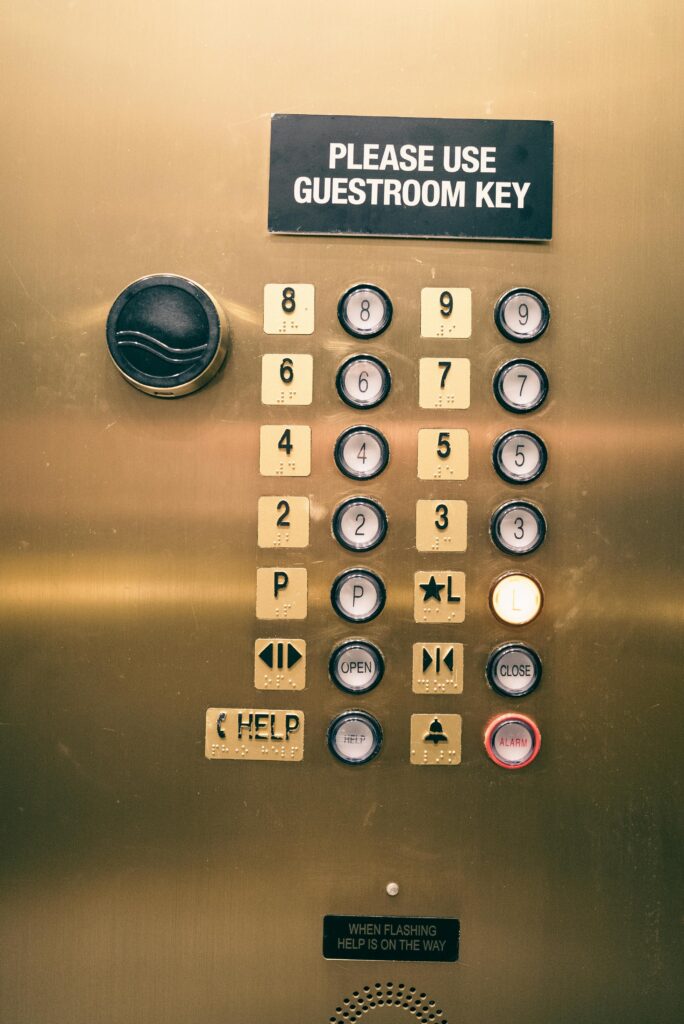
If you were injured in an elevator that suddenly dropped, stopped abruptly, mis-leveled at a floor, or failed to reopen its doors when something was in the path, at a hotel, casino, office building, or apartment building in Las Vegas, the answer to “who is responsible” is almost always more than one party.
The short answer: elevator cases typically involve at least two defendants, often three. The property owner (hotel, casino, or building operator), the elevator maintenance contractor (typically Otis, KONE, Schindler, or TK Elevator), and sometimes the elevator manufacturer where a component defect contributed.
Nevada has a robust elevator regulatory framework that most injured riders do not know exists. Under NAC Chapter 455C, the Mechanical Compliance Section of the Nevada Department of Business and Industry, Division of Industrial Relations, is the authority having jurisdiction over every elevator in the state. The Mechanical Compliance Section adopts the ASME A17.1 (2019) Safety Code for Elevators and Escalators by reference in NAC 455C.500. Critically, NAC 455C.526 requires the elevator owner to promptly notify the Mechanical Compliance Section of every accident involving the elevator, and the elevator must be shut down and investigated by a State of Nevada Safety Specialist. This creates a paper trail of discoverable evidence that exists in nearly every Nevada elevator injury case, whether or not the injured rider was told about it.
Why Elevator Drop Cases Involve Multiple Defendants
Elevator operations sit at the intersection of three independent duty layers:
- The property owner owes a non-delegable duty to maintain safe premises for invitees, a duty that cannot be escaped by hiring a contractor to do the maintenance work.
- The elevator maintenance contractor owes a contractual duty to perform inspection, lubrication, adjustment, and repair work to the standard set by ASME A17.1 and the maintenance contract itself.
- The elevator manufacturer owes product liability obligations for the design, manufacture, and warning adequacy of the equipment.
Each duty layer is independently insurable, and each is typically held by a different carrier. When an elevator malfunctions and injures a rider, the question is rarely “which of these three is responsible.” It is more often “what is each one’s allocable share, and which insurance layer pays first.”
This structural reality is why elevator cases require coordinated identification of every potential defendant before settlement discussions begin with any single party. Settling with one defendant on a multi-defendant elevator case can prejudice claims against the others if the settlement is not structured carefully.
The Defendant Menu
| Defendant | When Applicable | Typical Theory of Liability |
|---|---|---|
| Property owner / hotel / casino / building operator | Almost always | Non-delegable duty for premises safety; failure to ensure proper maintenance regardless of who performs it |
| Elevator maintenance contractor | Almost always (separate maintenance contract exists) | Negligent maintenance per ASME A17.1 standards and the maintenance contract |
| Elevator manufacturer | Component defect contributed (design or manufacturing) | Product liability: design defect, manufacturing defect, or failure to warn |
| Modernization or alteration contractor | Recent modernization or repair contributed | Negligence in installation, alteration, or repair work |
The major elevator service companies operating in the Las Vegas market are Otis Elevator Company, KONE, Schindler, and TK Elevator (formerly ThyssenKrupp Elevator). Identifying which company services the specific elevator is a discoverable fact. The maintenance contractor’s information typically appears on the inspection certificate posted in the elevator car, on the door rating plate, or on the machine-room signage that NAC 455C requires to be maintained. (For a parallel multi-defendant fixture-failure framework in a different setting, see our analysis of casino chair collapse injuries.)
Common Failure Modes and What Each Points At
Different elevator failure modes implicate different components, different maintenance procedures, and therefore different evidence. The four most common in elevator injury cases each point at a specific part of the system. (For escalator-specific incidents, which involve different machines, different defendants, and different failure modes, see our companion article on escalator malfunctions and injuries.)
| Failure Mode | What It Looks Like | Component Implicated | Evidence Trail |
|---|---|---|---|
| Governor / overspeed protection | Free-fall or sudden hard-stop | Governor (detects excessive descent speed, triggers safety brake on car frame) | Governor inspection records, last-test date, tripping speed measurement |
| Machine brake | Uncontrolled descent or upward motion, mis-leveling at floor stops, door-zone failures | Machine brake (holds car at floor, provides emergency stopping) | Brake adjustment records, brake pad wear measurements, recent brake service log |
| Leveling system | Car stops several inches above or below floor; trip-fall hazard | Leveling switches (detect when car is at floor level) | Leveling switch calibration records, door-zone position measurements, floor-level offset history |
| Door reopening device | Door entrapment, crushing injuries | Infrared edge or 3D detection system (detects obstruction in door path) | Door reopening device test records, sensor calibration history, recent door-system service log |
A fifth failure mode is increasingly relevant in Nevada cases: unintended motion. ASME A17.3 (2020), adopted by Nevada in August 2021 under NAC 455C.500 and retroactively applicable to existing elevators, requires devices that prevent unintended motion of the car when the doors are open and monitor electrical contacts on door locks. Older Nevada elevators that have not been retrofitted to A17.3 (2020) standards may be operating in noncompliance, an avenue for negligence per se against the property owner and the maintenance contractor.
Nevada’s Regulatory Framework: What Most Riders Don’t Know
Nevada’s elevator regulatory architecture produces several types of discoverable evidence that often does not appear in initial accident records.
State inspections. Under NAC 455C.518 and 455C.516, elevators must be inspected by an inspector or special inspector at intervals ranging from three months to four years depending on equipment type. Each inspection produces a state inspection report retained by the Mechanical Compliance Section.
Mandatory accident notification. Under NAC 455C.526, the elevator owner or its agent must promptly notify the Mechanical Compliance Section of every accident involving the elevator. The Mechanical Compliance Section then conducts its own investigation through a State Safety Specialist, and the elevator must be shut down until the investigation is complete. The resulting MCS accident investigation report is a discoverable document that often contains findings, observations, and code-violation citations. These are documents that may not surface without specific document requests.
Maintenance Control Program. Under NAC 455C.504, the elevator owner must file a written Maintenance Control Program (MCP) with the Mechanical Compliance Section before an operating permit can be issued. The MCP describes the scheduled maintenance tasks and frequencies for the elevator. Maintenance records tracking actual work against the MCP must be kept onsite and made available to inspectors and special inspectors at the time of inspection. Both the MCP and the maintenance records are the property of the owner. In litigation, the MCP and the records together establish what maintenance was supposed to happen and what actually did.
Machine room incident log. Nevada regulations require a written log in the elevator machine room where each elevator mechanic must enter information about every incident they respond to: the reported trouble, date, time, and corrective action taken. This log persists across maintenance visits and across changes of contractor. It is one of the most powerful evidence sources in a multi-incident elevator case because it shows whether the property owner and contractor knew about a recurring problem before the accident occurred.
Code adoption. ASME A17.1 (2019) is the governing safety code under NAC 455C.500. ASME A17.3 (2020), the code for existing elevators, was adopted in August 2021 with retroactive requirements. ASME A17.2 (Guide for Inspection) and QEI-1 (Inspector Qualification Standard) are also adopted by reference. A code violation that contributed to the injury supports a Nevada negligence per se analysis against any defendant who owed a duty under the violated code section.
Discovery diagnostic. When an elevator injury occurs in Nevada and these documents are not produced in early discovery (especially the MCS accident report, the MCP and maintenance records, and the machine room incident log), that itself is a signal that the case has not been fully developed.
The Maintenance Contract as the Central Document
The maintenance contract between the property owner and the elevator service company is often the single highest-value private document in an elevator injury case. (The MCP filed with MCS under NAC 455C.504 is the highest-value regulatory document; the two work in parallel.) Maintenance contracts allocate duty in ways that directly affect liability:
| Contract Type | Contractor’s Scope | Liability Implication |
|---|---|---|
| Full Maintenance | Inspection, lubrication, adjustment, repair of essentially all components | Strong liability target for nearly any mechanical failure |
| Parts and Labor (P&L) | Routine maintenance, but excludes major component replacement | Major component replacement remains owner’s responsibility |
| On-Call Only | Callout-response duties only | Most preventive maintenance with the owner |
The contract type determines which party owed the duty that was breached. Equally important, maintenance contracts contain indemnification and insurance provisions that allocate liability between the parties when an injury claim arises. These provisions are typically not visible to the injured rider but are obtainable through litigation discovery.
Evidence Specifically Required for These Cases
Elevator drop cases require a specific evidence-development pathway:
- Mechanical Compliance Section accident investigation report. Request from the MCS via public records request and through formal discovery.
- Mechanical Compliance Section prior inspection reports for the specific elevator. These establish the inspection history and any prior code violations.
- The Maintenance Control Program filed under NAC 455C.504 and the maintenance records tracking actual work against the program. Both are required to be kept onsite and available to inspectors; both are discoverable.
- Machine room written incident log. Required by NAC; subpoena from the property owner or contractor.
- The maintenance contract between property owner and elevator service company. Discoverable; often outcome-determinative on liability allocation.
- The maintenance company’s service records for the specific elevator. Every callout, every adjustment, every repair.
- The elevator’s manufacturer information, model, and installation date. Establishes age, expected component life, and any applicable manufacturer recall or service bulletin.
- Surveillance footage from the elevator car (modern elevators have interior cameras) and from the lobby. Retention windows are typically 30 to 90 days.
- The inspection certificate posted in the car. Shows last inspection date and inspector identity.
- Witness statements. Other passengers in the car or waiting in the lobby.
- Medical records documenting the injury mechanism. Sudden deceleration spinal injuries, door impact, and falls from leveling mismatch each leave distinct medical signatures.
Timeline: What to Do in the First Two Years
Statute of limitations: 2 years from the date of injury. The Nevada statute of limitations on personal injury claims under NRS 11.190 is two years.
If you were injured in an elevator drop or malfunction in Las Vegas, the timing of these actions matters:
- Immediately. Seek medical evaluation. Sudden deceleration injuries (cervical and lumbar spine, knee, ankle) and door-impact injuries can present subtly and worsen over time. The medical record establishes the injury mechanism.
- Within 24 hours. Note the elevator car number, the property name and address, and the time of the incident. Photograph the inspection certificate posted in the car if you can return safely. Confirm with the property that the accident was reported to the Nevada Mechanical Compliance Section as required by NAC 455C.526. If the property has not reported, that itself is significant.
- Within 7 days. Identify the elevator maintenance contractor (Otis, KONE, Schindler, TK Elevator, or another service company). The contractor name typically appears on the door rating plate, the inspection certificate, or the machine-room signage.
- Within 30 days. Surveillance footage retention windows in commercial properties typically run 30 to 90 days. A formal preservation letter is the most reliable way to ensure footage is not overwritten.
Triggers for legal evaluation:
- Any case where the elevator had prior reported issues
- Any case where multiple parties (hotel, contractor, manufacturer) are potentially involved
- Any case where the property is offering an early settlement or release
- Any case approaching the surveillance-footage retention window
Note that the owner’s non-delegable duty keeps the property in the case even when the maintenance contractor is the primary fact target.
How a Personal Injury Attorney Evaluates These Cases
Elevator injury cases require coordinated identification of every potentially liable party (property owner, maintenance contractor, manufacturer, and any modernization or alteration contractor) and disciplined development of the regulatory paper trail. The Mechanical Compliance Section accident report, the Maintenance Control Program filed under NAC 455C.504, the maintenance records, and the machine room incident log together establish what was supposed to happen, what actually happened, and what the parties knew before the incident. These documents often do not surface without specific requests. The maintenance contract between owner and contractor, in turn, is the document that frequently determines which carrier ultimately pays.
With over 40 years as a personal injury attorney, Jack Bernstein understands how multi-defendant premises and product cases unfold, including the evidence-development sequence that determines whether a case rests on the property owner alone or extends to the maintenance contractor and manufacturer. If you were injured in an elevator drop or malfunction at a Las Vegas hotel, casino, or other building, Jack Bernstein Injury Lawyers offers a free consultation to evaluate which defendants and which insurance layers are in play in your specific situation. Call (702) 633-3333.