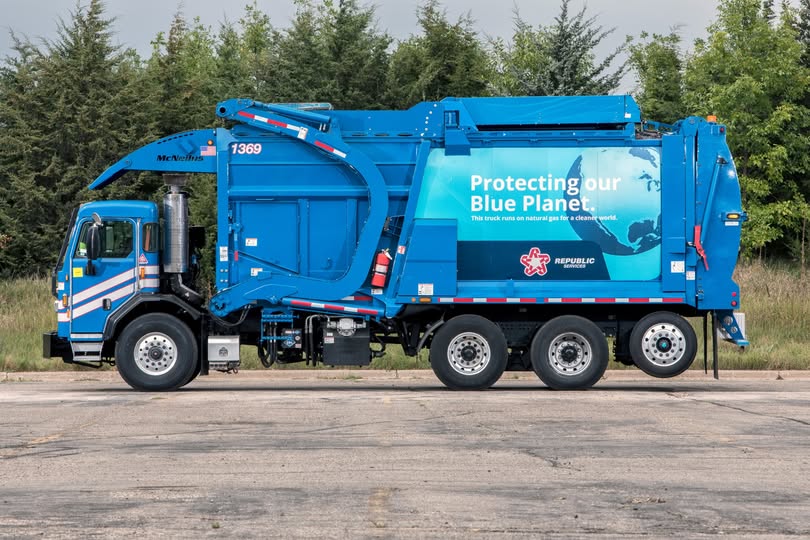
If you were hit by or in a collision with a garbage truck in Southern Nevada (Las Vegas, North Las Vegas, Henderson, or unincorporated Clark County), the case is almost certainly not a government tort claim. It is a private commercial vehicle case.
Republic Services holds exclusive municipal solid waste franchises across all four Southern Nevada jurisdictions and has held them for decades: City of Las Vegas since 1985, Clark County since 1993, North Las Vegas since 1978, and Henderson since 1973. The current franchise agreements run through approximately 2031 to 2035 depending on jurisdiction. Republic Services is a publicly traded company (NYSE: RSG), not a government entity.
The standard residential or commercial garbage truck collision in Southern Nevada is litigated against a private corporate defendant under standard commercial trucking law, not under the NRS 41.031 governmental tort claims framework with its $200,000 damages cap, notice procedure, and bar on punitive damages.
The municipal claim framework only applies in narrower edge cases: non-sanitation municipal fleet vehicles (street sweepers, parks dump trucks, public works) operated directly by municipal employees, or garbage truck operations in rural Nevada jurisdictions outside the Republic Services franchise area.
The structural reframe is significant. A private commercial trucking case generally provides a more favorable posture than a governmental tort claim: the damages cap does not apply, punitive damages remain available where supported by the facts, and the defendant carries substantial commercial insurance under federal interstate carrier requirements. The rest of this article covers the Republic Services franchise reality, the private-versus-municipal liability comparison, the narrow government-claim edge cases, the federal motor carrier framework, garbage-truck-specific operational hazards, the evidence required, and what to do within Nevada’s two-year statute of limitations.
The Republic Services Franchise Reality in Southern Nevada
Most Southern Nevada residents and visitors do not realize that the garbage trucks on their streets are operated by a single private contractor. Republic Services, headquartered in Phoenix, Arizona, is the second-largest waste management company in the United States after Waste Management Inc. In Southern Nevada, Republic operates under exclusive franchise agreements with each of the four major jurisdictions:
| Jurisdiction | Franchise begins | Current term |
|---|---|---|
| City of Las Vegas | 1985 | Multi-year extension through 2031 |
| Clark County (unincorporated) | 1993 | Through 2035 |
| North Las Vegas | 1978 | Through 2031 |
| Henderson | 1973 | Through 2035 |
The franchise dates are documented in Las Vegas Review-Journal coverage of Republic Services franchise agreements across Southern Nevada. The franchises are exclusive: no competitor is permitted to collect municipal solid waste in the franchise areas (construction and demolition waste is a separate, competitive market since 2005). The practical consequence for an injured person is that virtually every residential garbage truck and every commercial dumpster pickup truck operating in Southern Nevada is a Republic Services vehicle.
Republic Services is publicly traded on the New York Stock Exchange under the ticker RSG. As a publicly traded interstate corporation, Republic carries substantial commercial general liability and commercial auto liability insurance at material policy limits, and is subject to federal motor carrier regulations applicable to interstate trucking operations.
Private Versus Municipal Liability: Why the Distinction Matters
When a case is against a private commercial defendant, standard Nevada tort law applies. When a case is against a governmental entity, the Nevada Tort Claims Act framework introduces multiple structural constraints. The differences materially affect both the recovery available and the procedural path:
| Issue | Private commercial defendant (Republic Services) | Governmental defendant (city/county vehicle) |
|---|---|---|
| Damages cap | None applicable | $200,000 per claimant under NRS 41.035, exclusive of interest |
| Punitive damages | Available where supported by clear and convincing evidence of oppression, fraud, or malice (NRS 42.005) | Barred under NRS 41.035 |
| Pre-suit notice | None required | NRS 41.036 two-year notice procedure (not strictly a condition precedent under 41.036(3) for the political subdivision itself, but required for claims against individual government employees under NRS 41.039) |
| Insurance | Commercial general liability + commercial auto liability under interstate carrier requirements | Self-insured pools or governmental risk management; coverage subject to statutory limits |
| Discovery | Standard civil rules | Standard civil rules with potential immunity-based limitations on certain types of records |
| Federal regulatory negligence per se | Available where FMCSR violation contributed to collision | Generally not applicable to municipal sanitation operations |
| Statute of limitations | Two years from injury (NRS 11.190) | Two years from injury (NRS 11.190); notice procedure within the same window |
The principal reframe for the typical Southern Nevada reader: garbage truck cases against Republic Services do not face the $200,000 cap. For serious injuries (fractures requiring surgery, traumatic brain injury, spinal cord injury, fatalities), full damages remain recoverable, subject only to standard tort principles and the available insurance coverage.
The Narrow Government-Claim Edge Cases
The municipal claim framework still applies in a handful of garbage-truck-adjacent fact patterns:
Non-sanitation municipal fleet vehicles confused for garbage trucks. A city or county street sweeper, a parks department dump truck, or a public works fleet vehicle operated directly by a municipal employee is a governmental defendant. These vehicles are sometimes mistaken for “garbage trucks” by witnesses or initial reporters. Identifying the specific vehicle type and operator is critical to choosing the correct legal path. The vehicle markings (such as “City of Las Vegas Public Works” versus “Republic Services”) typically resolve this question on inspection.
Rural Nevada jurisdictions. Republic Services’ Southern Nevada franchise covers Las Vegas, North Las Vegas, Henderson, and Clark County. Garbage truck operations in other Nevada counties or rural jurisdictions may be municipal, may be served by a different private contractor, or may operate under a different franchise structure. A garbage truck collision in Pahrump, Mesquite, or other Nevada locations outside the Southern Nevada franchise area requires separate identification of the operator.
Government-leased or government-operated waste collection. A handful of state, federal, or special-district facilities (military installations, federal land, certain governmental properties) may operate their own waste collection. Collisions involving such operations follow the governmental claim framework.
In the small set of cases where the governmental path applies, the procedural requirements under NRS 41.036 (filing notice with the political subdivision’s governing body within two years) and the substantive limitations under NRS 41.035 (cap, no punitive damages) become the central considerations. The full Nevada Tort Claims Act framework appears in NRS Chapter 41.
Federal Motor Carrier Regulations Apply to Republic Services Trucks
Republic Services operates as an interstate motor carrier subject to the Federal Motor Carrier Safety Regulations (FMCSR) under 49 CFR Parts 350-399. The impact of federal regulations in truck accidents is consistent across the commercial motor carrier industry; the applicable rules generate substantial discoverable evidence:
- 49 CFR Part 391: Driver qualification requirements: medical certifications, driving records, employment history, training records. Republic is required to maintain a Driver Qualification File (DQF) for each driver.
- 49 CFR Part 395: Hours-of-service rules: limits on driving time and on-duty time. Electronic Logging Device (ELD) data is discoverable and shows the driver’s hours leading up to the collision.
- 49 CFR Part 396: Vehicle inspection, repair, and maintenance: required pre-trip inspections, periodic maintenance, defect documentation. The role of commercial vehicle safety inspections and accident liability is well-documented in trucking case law; vehicle maintenance files are discoverable.
- 49 CFR Part 382: Drug and alcohol testing: pre-employment, random, post-accident, and reasonable-suspicion testing requirements. Post-accident drug and alcohol testing must occur within specific time windows after a qualifying accident.
A federal motor carrier safety regulation violation that contributed to the collision supports a Nevada negligence per se analysis: the regulatory violation establishes the breach of duty, and the plaintiff must prove causation and damages.
Garbage-Truck-Specific Operational Hazards
Garbage trucks operate differently from over-the-road commercial trucks, and their failure modes reflect that operational reality:
Significant blind spots. Garbage trucks have substantial blind spots on the passenger side, directly behind, and immediately in front of the cab. Many incidents involve pedestrians or cyclists in zones the driver cannot see from the cab. The dynamics of truck blind spot accidents and the commercial no-zone defense apply with additional intensity in residential neighborhoods, where cyclists and pedestrians are more likely to be present in those zones.
Side-loader versus rear-loader configurations. Side-loader trucks (single-operator, mechanical arm pickup) and rear-loader trucks (multi-operator, manual or hopper-fed) have different operational profiles. Rear-loader operations involve helpers entering and exiting the truck repeatedly; the helper may be in the path of other vehicles or struck by the truck itself during a missed cab-mirror check.
Frequent starts and stops on residential streets. The route operation involves dozens of stops per mile in residential collection. Traffic following a garbage truck may not anticipate the next stop. Failure to use proper warning signals, hazard lights, or backup alarms is a recurring issue.
Backing maneuvers. Garbage truck backing operations are responsible for a disproportionate share of pedestrian and parked-vehicle incidents nationally. OSHA and FMCSA both address backing safety; spotter requirements and backup alarm requirements vary by jurisdiction and operation.
Route time pressure. Collection routes are operationally timed. Time pressure to complete a route can correlate with reduced attention to pedestrian and cyclist hazards on residential streets.
Evidence Specifically Required for These Cases
Garbage truck collision cases require a specific evidence-development pathway:
- The truck identification number: Republic Services trucks display unit numbers on the vehicle. Recording the specific truck identifies the route, the driver, the maintenance file, and the ELD data.
- The Driver Qualification File: required under 49 CFR Part 391; discoverable. The DQF supports analysis of negligent hiring claims against the trucking company where the carrier failed to vet the driver appropriately.
- Electronic Logging Device data: the driver’s hours of service for the relevant period.
- Vehicle maintenance records: pre-trip inspections, periodic maintenance, defect documentation under Part 396. Where maintenance failures contributed to the collision, a truck accident caused by improper maintenance creates a separate liability theory against the carrier.
- Post-accident drug and alcohol testing records: required after qualifying accidents under Part 382.
- Route records and dispatch records: establish where the truck was assigned and what time pressure existed on the route.
- Truck-mounted camera footage: most modern garbage trucks operate multiple cameras (front, rear, side, hopper) for operational and insurance documentation purposes. Footage retention windows vary; requests must move quickly.
- Witness contact information: neighbors along residential routes are common witnesses; collection operations are visible.
- Medical records documenting the injury mechanism: pedestrian impact, vehicle-on-vehicle collision, secondary fall injuries.
- The Republic Services accident report: generated internally; discoverable.
What to Do, When to Act
If you were injured in a garbage truck collision in Southern Nevada, the timing of these actions matters:
- Immediately: Seek medical evaluation. Garbage truck collisions often involve significant impact forces; injuries may not present immediately.
- Within 24 hours: Record the truck number visible on the vehicle, the time and exact location, and any witness contact information. Photograph any damage and the scene if you can do so safely.
- Within 7 days: Confirm the operator. The vehicle markings will clearly indicate Republic Services or, in narrower cases, the relevant municipal agency. This determines whether the case follows the private or governmental path.
- Within 30 days: Truck-mounted camera footage retention windows can be short. A formal preservation letter or subpoena to Republic Services is the most reliable way to ensure footage is not overwritten.
- Within 90 days: Engage legal counsel before signing anything from Republic’s claims department or any insurance carrier. Early settlement offers may not reflect the full case value, particularly for injuries that are still being diagnosed.
- Within 2 years: The Nevada statute of limitations under NRS 11.190 is two years from the date of injury. If the case is one of the narrow governmental edge cases, the NRS 41.036 notice should be filed within the same window.
Triggers for legal evaluation include any garbage truck collision with serious injury, any case where the operator is being misidentified (governmental versus Republic), any case where Republic’s claims department is offering an early settlement, and any case approaching the camera-footage retention window.
How a Personal Injury Attorney Evaluates These Cases
Garbage truck cases turn on correctly identifying the operator (Republic Services in nearly all Southern Nevada cases; a governmental entity in narrow edge cases), developing the federal motor carrier evidence record (Driver Qualification File, ELD data, vehicle maintenance records), and recognizing the specific operational hazards that distinguish sanitation operations from over-the-road trucking. Republic Services is a sophisticated corporate defendant that tenders claims promptly to experienced commercial auto carriers; effective representation requires understanding the structural posture before settlement discussions begin.
With over 40 years as a personal injury attorney, Jack Bernstein understands how commercial trucking cases unfold, including the federal regulatory framework that produces discoverable evidence and the carrier-coordination dynamics that determine which insurance policy ultimately responds. If you were injured in a garbage truck collision in Las Vegas, North Las Vegas, Henderson, or Clark County, Jack Bernstein Injury Lawyers offers a free consultation to evaluate the specific operator, the regulatory evidence available, and the insurance posture in your situation. Call (702) 633-3333.