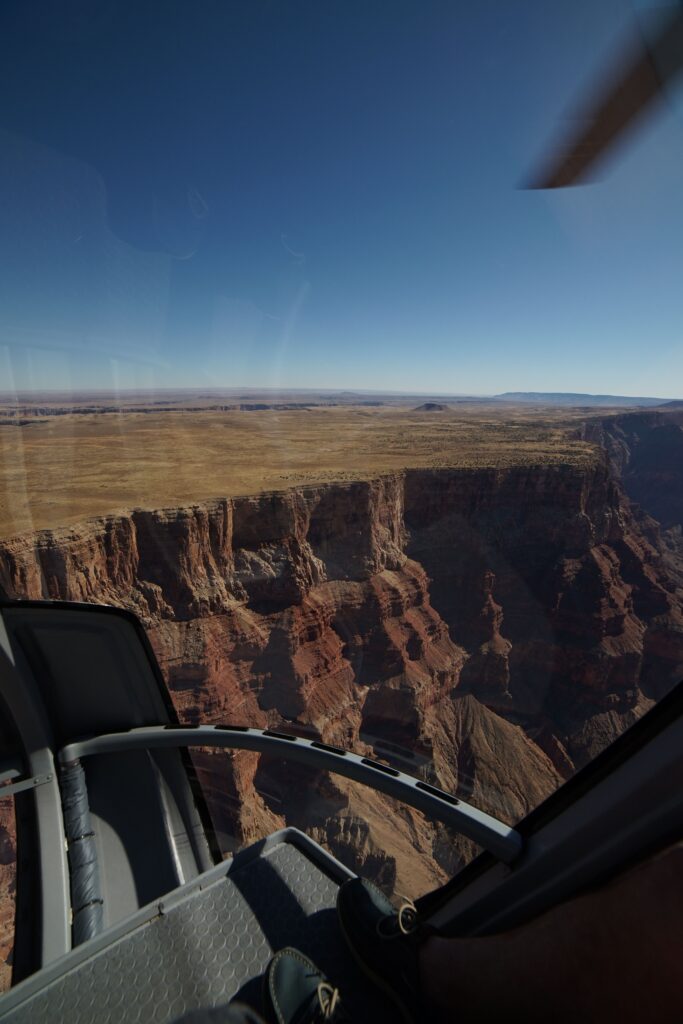
Most Grand Canyon helicopter tours lift off from the Las Vegas area, which means that when one of these flights ends in a crash, the people left to make sense of it are often visiting from somewhere else, grieving, and being told the same thing by everyone they talk to: wait for the investigation. An air-tour case does not work like an ordinary car accident, and the instinct to wait can quietly cost a family the very evidence and the very deadline that decide whether anything can be done at all.
What You Need to Know
- An air-tour crash almost always involves more than one responsible party. The tour operator, the pilot, the company that maintained the aircraft, and the manufacturer of the helicopter or a failed component can each be a separate defendant, each with its own insurance. Treating it as “the helicopter company’s fault” alone often leaves recovery on the table.
- The NTSB report will not be your proof, and you should not wait for it. Federal law keeps the Board’s accident report (the part that assigns probable cause) out of a civil damages case entirely. The underlying factual data is treated differently, but the formal report that families wait twelve to twenty-four months to read cannot be put in front of a jury. The clock on your claim runs the whole time.
- “It’s federal, so you can’t sue” is wrong. Federal aviation law sets the safety standard a pilot and operator are judged against, but it expressly preserves your right to bring a state-law claim for damages. Preemption shapes how the case is proven; it does not close the courthouse.
- Which state’s law applies is a real question, not an automatic one. A tour sold and boarded in Nevada that crashes in Arizona or on tribal land raises a choice-of-law issue. Where the crash happened does not, by itself, decide which state’s law governs.
- A fatal air-tour crash is a wrongful-death case with a firm two-year deadline. In Nevada that clock runs two years from the date of death, and the people who can recover are defined by statute.
If This Just Happened
If a tour flight you or a family member was on has crashed in the last few days, a few things matter before anything else, and none of them require waiting for an investigator.
Preserve everything you already have: the booking confirmation, the receipt, the waiver you signed, the name of the operator, photos, and any communication from the company. If a representative from the tour operator or its insurer contacts you (and they often reach out quickly, sometimes framed as checking on your well-being), you are not obligated to give a recorded statement or sign anything, and it is reasonable to decline until you have spoken with your own attorney.
The aircraft wreckage itself will be in federal custody during the investigation, which is normal. That does not stop a civil claim from beginning, and it does not stop the evidence around the crash (maintenance records, the operator’s certificates, weather data, witness accounts) from being preserved while memories are fresh. The single most damaging assumption a family can make is that nothing can happen until the final report is published. By then, the two-year deadline may be much closer than anyone realized.
Who Is Actually Responsible for an Air-Tour Crash?
The honest answer is usually “more parties than the family first sees.” A helicopter tour is a chain of separate businesses and decisions, and a crash can trace back to any link in that chain. Sorting out who is responsible is the first real piece of legal work in these cases, and it is where the value of an experienced evaluation shows up immediately.
The common defendants line up like this.
| Potential defendant | Why they may be liable | Governing standard |
|---|---|---|
| The tour operator | Holds the federal air-carrier certificate and is responsible for how the operation is run: crew scheduling, dispatch decisions, weather calls, and overall safety management. | Federal operating rules for commercial air tours, applied through a state-law negligence claim. |
| The pilot | Directly operates the aircraft; errors in judgment, route, or handling fall here. The operator is generally responsible for its pilot’s conduct on the job. | The federal “careless or reckless” operating standard. |
| The maintenance provider | Whoever inspected, serviced, or signed off on the aircraft. A maintenance lapse that contributes to a mechanical failure creates exposure separate from the pilot. | Federal maintenance requirements, applied through a negligence claim. |
| The manufacturer | The maker of the helicopter or of a specific component that failed. A design or manufacturing defect is a product-liability claim that stands on its own. | State product-liability law, which carries a different preemption analysis than the operational claims. |
Why this matters for your family: when more than one defendant is responsible, more than one insurance policy may be available, and the way Nevada allocates fault among defendants is not a footnote. Under NRS 41.141, Nevada generally makes defendants liable only for their own share of fault, with an important exception for product-liability claims, where defendants can remain jointly responsible. That distinction is one reason the manufacturer is rarely a defendant to overlook.
Why an Air-Tour Operator Is Held to a High Standard
Companies that carry paying passengers have long been treated as common carriers, a legal category that, in Nevada, has historically carried a heightened duty of care toward passengers. The Nevada Supreme Court confirmed in First Transit, Inc. v. Chernikoff, 135 Nev. Adv. Op. 32 (2019) that “Long-standing Nevada case law holds that a common carrier owes a heightened duty of care to its passengers,” while clarifying that the heightened duty “only applies to transportation-related risks,” meaning the risks of the carriage itself.
Two honest caveats belong with that rule. First Transit was a bus case, and no Nevada appellate court has yet applied the common-carrier standard specifically to an air-tour operator, so the heightened-duty framing is a backdrop rather than a settled aircraft holding. And in the air, a second standard does most of the work anyway.
That second standard is federal. For the actual operation of the aircraft, including how it was flown, dispatched, and maintained, federal aviation law supplies the standard of care, which is the rule against operating an aircraft in a “careless or reckless” manner. Courts in the federal circuit that covers Nevada and Arizona have held that this federal standard governs in-flight operations, displacing a separate state-law standard for the same conduct. What it does not do is take away the family’s claim, and that is the next, most-misunderstood point.
What the NTSB and FAA Investigation Actually Means for Your Claim
After a fatal or serious air-tour crash, the National Transportation Safety Board opens an investigation and the Federal Aviation Administration is involved in the regulatory side. Families understandably treat the resulting report as the answer to “what happened and whose fault was it.” For a civil claim, that instinct is the single most common and most costly misunderstanding.
Federal law is explicit. Under 49 U.S.C. § 1154(b), “No part of a report of the Board, related to an accident or an investigation of an accident, may be admitted into evidence or used in a civil action for damages resulting from a matter mentioned in the report.” The Board’s report, the document that states a probable cause and reflects the agency’s analysis, is kept out of a damages lawsuit by statute. Courts have generally drawn a line between that formal report and the underlying factual material an investigation gathers (data, measurements, physical findings), which is treated separately and is often usable. But the conclusion families wait for, the probable-cause finding, is the part the law specifically excludes.
What this means for you: the report you may be waiting one to two years to read will not be handed to a jury as proof of fault, and the deadline to file does not pause while you wait for it. A civil claim has to develop its own evidence and its own experts. Treating the NTSB’s eventual conclusion as your case is how families let both the evidence and the clock slip away.
The practical takeaway is that the investigation and your claim are two different tracks running at the same time. The investigation answers the public-safety question on the government’s schedule. Your claim answers the compensation question on the law’s schedule, and that schedule does not wait.
Does Federal Law Stop You From Suing?
Short answer: no. The longer answer is the reason air-tour cases need handling that ordinary accident practice does not reach.
Federal aviation law occupies the field of aviation safety standards. When a court applies that principle, the standard of care for how an aircraft is operated comes from federal regulation rather than from a state’s common law. That sounds, at first, like it might wipe out a state lawsuit. It does not, because the same body of federal law contains a savings clause that expressly preserves state-law remedies for damages. In plain terms: the federal rules supply the standard the defendant is measured against, and state law supplies the claim and the recovery when that standard is violated.
There is also a meaningful split between the operational claims and the product claims. The preemption of the standard of care has been applied to “in-air” operations such as flying, dispatching, and maintaining. Claims that a component or the aircraft itself was defectively designed or built have been treated differently by the courts, leaving room for a state product-liability standard. For a family, the consequence is concrete: the case against the operator and the case against the manufacturer may proceed on different legal footings, which is one more reason the multi-defendant structure is not a technicality.
What this means for you: if anyone tells you that a crash is “a federal matter” and there is nothing a civil attorney can do, that is not how the law works. Preemption changes how the case is built and which standard the defendant is judged by; it does not take away your right to bring it.
Which State’s Law Applies, Nevada or Arizona?
A Las Vegas-departing tour that crashes over the Grand Canyon presents a genuine puzzle: the trip was sold and boarded in Nevada, but the crash site may be in Arizona, and some Grand Canyon airspace sits over tribal land. Which state’s law governs the case is not answered simply by pointing at the map.
Nevada uses what courts call the most-significant-relationship test, drawn from the Restatement (Second) of Conflict of Laws and adopted in General Motors Corp. v. Eighth Judicial District Court, 122 Nev. 466, 134 P.3d 111 (2006). Under that approach, the law of the place where the injury occurred is the starting presumption, but it is rebuttable. If another state has a more significant relationship to the parties and the issue, that state’s law can apply instead. Where both the company and the passengers have ties to Nevada, where the tour was sold and operated, and where the relationship between the parties was formed all weigh in the analysis.
What this means for you: do not assume that because the crash happened in Arizona, Arizona law and an Arizona court automatically control, and do not assume the opposite either. The forum and the governing law are themselves contested questions in an air-tour case, and they can affect the deadlines, the available damages, and the value of the claim. Getting that analysis right early is part of the legal work, not an afterthought.
When the Crash Is Fatal: The Wrongful-Death Overlap
Air-tour crashes are disproportionately fatal, which means many of these matters are wrongful-death cases from the start. Nevada’s wrongful-death statute, NRS 41.085, defines who may recover and what they may recover. The decedent’s heirs may seek compensation for their own losses (grief and sorrow, loss of probable support, and the loss of the companionship, society, comfort, and consortium of the person who died), while the estate’s personal representative may pursue the losses belonging to the decedent. The proceeds recovered by the heirs are protected from the decedent’s creditors in a way the estate’s recovery is not, which is one reason how a wrongful-death claim is structured matters as much as whether it is brought.
The deadline is firm. A Nevada wrongful-death claim must generally be brought within two years of the date of death. Because air-tour investigations stretch far past that window, the wrongful-death clock is the clearest example of why waiting for the report is the wrong move.
The valuation of a wrongful-death claim, including how lost support, future earnings, and the value of a life are calculated for a decedent who was retired, very young, or not earning income, is its own deep subject. If your situation involves a fatal crash, the Nevada wrongful death practice area covers that ground, and the firm’s writing on wrongful death involving a decedent with no income and the wrongful death of a child addresses the valuation questions families ask most.
What to Do Now
The actions that protect an air-tour case are front-loaded. The earlier they happen, the more evidence survives and the more room there is to make decisions deliberately rather than under deadline pressure.
- Preserve every document tied to the booking and the flight: the reservation, receipt, waiver, the operator’s name and certificate information, and any photos or video.
- Decline to give a recorded statement to the operator or its insurer, and avoid signing any release, until you have spoken with your own attorney.
- Identify the parties early: the operator, the pilot’s employer, the maintenance provider, and the aircraft or component manufacturer. Each may be a separate defendant with separate coverage.
- Do not wait for the NTSB report. The investigation runs on its own schedule; the deadline to file your claim does not pause for it.
- Calendar the deadline. A Nevada wrongful-death claim generally must be filed within two years of the date of death, and that deadline is not extended by an ongoing federal investigation.
Common Questions
Can I sue if the crash is still under NTSB investigation?
Yes. The civil claim and the federal investigation are separate tracks. Waiting for the investigation to conclude does not improve your claim and can cost you evidence and time against the filing deadline.
Will the NTSB’s probable-cause finding prove my case?
No. By statute, the Board’s accident report cannot be admitted into evidence in a civil damages case. The underlying factual data is treated differently, but a civil claim must develop its own evidence and experts rather than rely on the report’s conclusion.
The crash happened in Arizona. Does that mean Arizona law applies?
Not automatically. Nevada applies a most-significant-relationship test in which the place of injury is a starting presumption that can be rebutted. Because the tour was sold and boarded in Nevada, which state’s law governs is a contested question that should be analyzed early.
Is the helicopter company the only one I can hold responsible?
Usually not. The operator, the pilot’s employer, the maintenance provider, and the aircraft or component manufacturer can each be a separate defendant, often with separate insurance coverage.
If You Were Injured in Las Vegas
If you or a family member was injured or killed on a Grand Canyon or Las Vegas-area air tour, the practical complications (out-of-state families, evidence held in federal custody, a multi-jurisdiction liability picture, and a hard filing deadline) are exactly the kind that benefit from early, experienced evaluation. General tourist-injury rights in Las Vegas and the logistics of being injured as a visitor are worth understanding, but an air-tour crash sits in its own corner of the law, and a catastrophic outcome may also intersect with catastrophic-injury representation.
With over 40 years as a personal injury attorney, Jack Bernstein understands how a multi-defendant catastrophe with a federal investigation and a contested choice of law unfolds, and how the evidence preserved in the first weeks shapes everything that follows. If you are facing the aftermath of a Grand Canyon or Las Vegas air-tour crash, Jack Bernstein Injury Lawyers offers a free consultation to help you understand who may be responsible, what the investigation does and does not mean for your claim, and which deadlines are already running. Because a Nevada wrongful-death claim generally must be filed within two years of the date of death, the time to evaluate your options is now. Jack Bernstein Injury Lawyers has recovered over $500 million in verdicts and settlements for injured Nevadans. Prior results do not guarantee a similar outcome. Call (702) 633-3333.