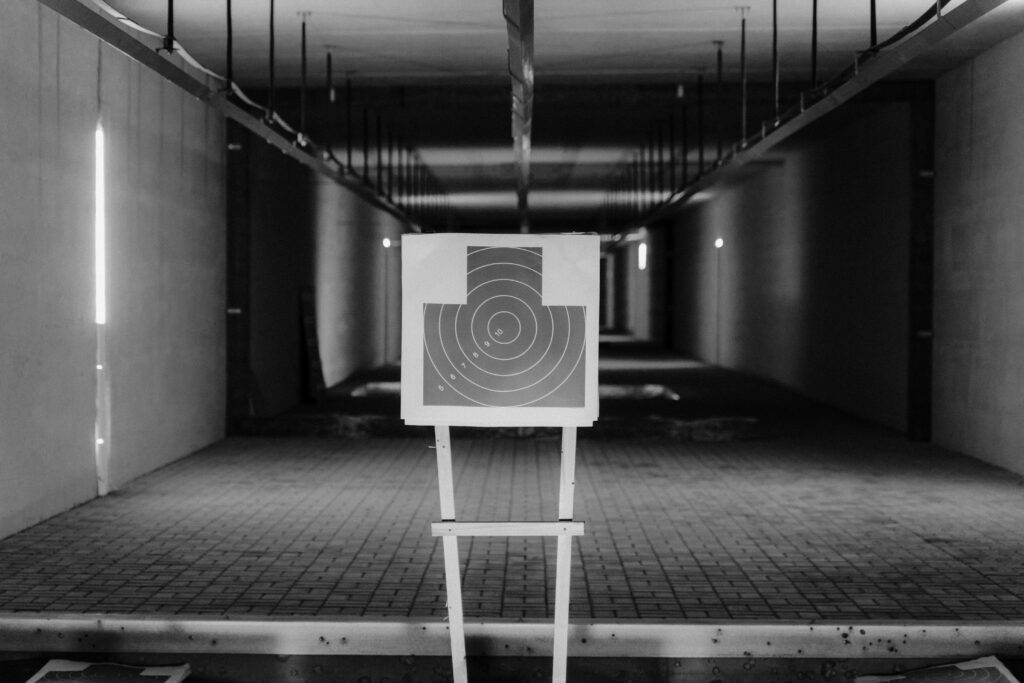
Las Vegas is the country’s unofficial capital of the “shoot a machine gun” experience. Tourists book it as a bucket-list outing, locals practice at indoor lanes, and the ranges market the activity as exciting but controlled. When someone is hurt at one of these facilities, the first thing the range tends to say is some version of the same sentence: you knew it was dangerous, you chose to do it, so this is on you.
That sentence is a legal argument, and in Nevada it is a weaker one than it sounds. A shooting range is a business that invites the public onto its property, and Nevada law holds businesses to a duty of reasonable care toward the people they invite in. Choosing to fire a gun does not erase that duty. The real question after a range injury is not “did I assume the risk” but “did the range do something a careful operator would not have done.”
What You Need to Know
- A Las Vegas shooting range owes its customers a duty of reasonable care, the same baseline duty every Nevada business owes lawful visitors. The Nevada Supreme Court unified that standard in Foster v. Costco Wholesale Corp., 128 Nev. 773, 291 P.3d 150 (2012), which built on Moody v. Manny’s Auto Repair, 110 Nev. 320, 871 P.2d 935 (1994): one duty of reasonable care to all lawful entrants, not a lesser duty because you walked in by choice.
- “You assumed the risk” is not a wall in Nevada. Under Mizushima v. Sunset Ranch, Inc., 737 P.2d 1158 (Nev. 1987), every form of implied assumption of risk is folded into comparative negligence. Choosing to shoot can reduce a recovery if your own conduct was careless, but it is not an automatic bar.
- There is no Nevada statute that sets range-safety rules. The only Nevada law that names shooting ranges, NRS 40.140, shields them from noise-nuisance lawsuits. It says nothing about supervision, lane design, or screening. The operator’s duty comes from general negligence law, measured against federal and industry safety standards.
- A signed waiver is not the end. Nevada enforces a release only if it clearly spells out that you are giving up claims for the operator’s own negligence, and a release cannot cover gross negligence.
- Nevada’s deadline is short. You generally have two years from the date of injury to file (NRS 11.190(4)(e)), and the range controls evidence that can be overwritten in days. Acting early matters.
If You Were Just Injured at a Range
If the injury is recent, a few steps protect your options before you do anything else. Get medical care and make sure the visit is documented, because the medical record is the spine of any later claim. Ask the range for a copy of the incident report and the names of any staff or witnesses present. If you are a visitor about to leave Las Vegas, this matters even more: a Nevada injury is generally governed by Nevada law and handled here regardless of where you live, and an attorney can preserve evidence and manage the claim remotely after you go home.
The reason for speed is that the most useful proof in a range case sits in the operator’s own files. Surveillance footage of the lanes, the rental and sign-in logs, instructor assignment sheets, maintenance records for the firearm or the lane equipment, and the original incident report are all in the range’s hands, and footage in particular is often overwritten within days unless someone asks for it to be preserved in writing. A short preservation letter sent early is frequently the difference between a documented case and a he-said-she-said one.
Does Choosing to Shoot Mean You Can’t Sue?
This is the belief that stops most people before they ever ask a lawyer, and in Nevada it is largely wrong.
The defense behind it is called assumption of risk. The idea is that if you voluntarily took on a known danger, the business owed you no duty and cannot be liable. Decades ago that defense could end a case outright. It no longer works that way in Nevada. In Mizushima v. Sunset Ranch, Inc., the Nevada Supreme Court held that “with the single exception of an express assumption of risk, the assumption of risk doctrine has been subsumed by our comparative negligence statute.” In plain terms, voluntarily encountering a risk is no longer a separate, automatic defeat. It becomes one factor a jury weighs when it divides fault between the parties.
Nevada went further than many states here. Some states keep a category called primary assumption of risk for the truly inherent dangers of an activity, the classic example being a fan hit by a foul ball at a baseball game, and treat it as a complete bar. The Mizushima court declined to keep even that, reasoning that “we perceive no valid reason for leaving primary implied assumption of risk intact” and that “the determination of duty is left to the jury as a factor in the comparative negligence analysis.” So the “you knew guns are dangerous” argument, in Nevada, is not a door that closes your case. It is a fault-allocation argument the range’s insurer will make to shrink what it pays.
There is a real distinction worth holding onto. Some risks are genuinely inherent to firing a gun: noise, recoil, the basic fact that live ammunition is involved. No one supervises those away. But an injury caused by how the range was run is a different thing entirely. A ricochet off a worn backstop, an untrained patron left without supervision, a malfunctioning rental firearm, a lane with no barrier between shooters, a visibly impaired customer who should have been turned away: those are not inherent risks of the sport. They are operational failures, and Nevada law treats them as negligence, not as something you signed up for by buying a range session.
What this means for you: the question is not whether shooting is dangerous. It is whether the range’s own conduct added a danger that careful operation would have prevented. If it did, choosing to shoot does not bar your claim. It may, at most, reduce it if your own carelessness contributed.
What Duties Does a Shooting Range Owe Its Customers?
Because a range is a business open to the public, it owes the unified duty of reasonable care that Foster and Moody require of every Nevada property operator. What that duty looks like in a range setting is specific, and it is the core of any negligence claim. A careful operator is expected to handle each of the following.
| Operator Duty | What Reasonable Care Looks Like | How It Fails |
|---|---|---|
| Competent instruction and supervision | Trained range safety personnel oversee the floor; first-time and rental shooters receive real instruction and active monitoring | A novice handed a firearm with no supervision; an unmanned lane during live fire |
| Safe lane and facility design | Barriers between lanes, sound backstops and baffles to control ricochet, adequate ventilation for indoor ranges | A degraded backstop that sends rounds back downrange; missing lane dividers |
| Working, maintained equipment | Rental firearms inspected and maintained; defective units pulled from service | A rental that malfunctions because maintenance was skipped |
| Patron screening | Refusing service to a visibly impaired or at-risk customer; basic fitness-to-handle checks | Renting a firearm to someone obviously intoxicated |
| Protective equipment | Providing and requiring eye and ear protection | Sending a shooter to the line without required protection |
| Downrange and ricochet safety | Enforcing muzzle-direction and lane rules; maintaining safe target distances and surfaces | Allowing conditions that make a ricochet or stray round foreseeable |
None of these are exotic. They are the ordinary expectations of a facility that puts live firearms in the hands of paying members of the public, many of whom have never fired a gun before. When a range breaches one of them and someone is hurt as a result, the breach is the negligence, and the injury is the harm it caused.
What this means for you: if you can point to which of these duties the range dropped, you have the spine of a negligence claim. The legal label matters less than the operational fact: a careful range would have done the thing the range did not do.
This is the same framework Nevada law applies to any property hazard. A range injury is one corner of Nevada premises liability, and the general standard for what counts as a dangerous condition on a business’s property is covered in depth in what constitutes a hazardous condition under Nevada premises liability law; a range injury is that framework applied to a firing line.
Is There a Nevada Law That Regulates Gun Ranges?
Many people assume there must be a state code that tells ranges exactly how to operate, and that proving a violation of it is how you win. In Nevada, that statute does not exist.
The only Nevada statute that mentions shooting ranges at all is NRS 40.140, and it runs in the opposite direction. It is a nuisance statute, and it protects ranges: a “shooting range does not constitute a nuisance with respect to any noise” attributable to the range as long as the range complies with applicable noise laws. The statute exists to shield ranges from neighbors suing over the sound of gunfire. It says nothing about how a range must supervise customers, design its lanes, or maintain its equipment. It is not a safety code, and it is not the source of the operator’s duty to you.
So where does the standard of care come from? Two places. First, the general negligence duty already described, which is judge-made and applies to every Nevada business. Second, the federal and industry standards that define what careful range operation looks like in practice. Indoor ranges are subject to federal workplace and environmental rules on airborne lead, including OSHA’s lead standard and its ventilation expectations, and the broader body of recognized range-safety practice supplies the yardstick a jury uses to decide whether the operator acted reasonably. A violation of one of those standards is not, by itself, a separate lawsuit you file; it is evidence that the range fell below the standard of care a reasonable operator would meet.
That distinction matters because it changes how a claim is built. You are not hunting for the one Nevada statute the range broke. You are showing that a competent operator, measured against accepted safety practice, would have prevented what happened, and that this range did not.
What this means for you: the absence of a Nevada range-safety statute is not a gap in your case. The duty of reasonable care fills it, and federal and industry safety standards give that duty concrete content.
What About the Waiver I Signed?
Almost every range has customers sign a release before they shoot, and many injured people assume that signature ends the conversation. It does not automatically.
Nevada does enforce pre-injury releases, but only on specific terms. To bar a negligence claim, the release has to clearly show that you were giving up claims for the business’s own negligence; vague “ride at your own risk” language does not get there. That is exactly where the waiver failed in Mizushima: the riding stable’s sign-up sheet did not work as a release because “there was no indication on the form that Sunset’s invitees were consenting to assume the risk of injury caused by Sunset’s own negligence.” A range’s standard waiver may or may not clear that bar, and the only way to know is to read the actual language against what happened.
A waiver also has limits it cannot cross. A release does not shield a business from gross negligence or reckless conduct, only from ordinary negligence, and even an enforceable release can be attacked if the language is buried, ambiguous, or overbroad. Whether a particular range waiver actually bars a particular claim is a fact-specific question that turns on the exact wording and what happened, which is exactly why a signed form is a reason to have the document reviewed rather than a reason to walk away. The enforceability of releases generally, and the line between ordinary and gross negligence, is its own deep topic; the short version is that a signature is the start of the analysis, not the end of it.
Who Is Liable, and How Fault Gets Divided
Range cases often involve more than one responsible party, and Nevada’s fault rules decide how much each one pays.
The range operator is the central defendant in most of these claims, because the operator controls supervision, lane design, equipment, and screening. But depending on what happened, other parties can share responsibility. If a rental firearm or its ammunition was defective, the manufacturer or distributor can be a defendant on a product-liability theory that runs alongside the negligence claim against the range. If the injury came from another customer’s conduct rather than a facility failure, the analysis shifts toward whether the range’s supervision was adequate and, in some patron-on-patron situations, toward the separate framework Nevada uses for harm caused by third parties on a property, which is covered in how to prove negligent security in a personal injury claim.
However the defendants line up, Nevada divides fault under its modified comparative negligence rule, NRS 41.141. The statute does not use the phrase “51 percent.” What it says is that an injured person’s own negligence “does not bar a recovery if that negligence was not greater than the negligence” of the parties they are suing. Read that carefully, because the comparison is against the combined fault of everyone you sue, not against any single defendant. If your share of the fault is not greater than theirs taken together, you can still recover, with your award reduced by your percentage. If your share tips past that line, recovery is barred.
This is precisely why the range’s insurer leans so hard on the “you assumed the risk” framing from the start. Since Mizushima turned that argument into a comparative-fault factor rather than a complete defense, the insurer’s strategy is to inflate your share of the blame, push it over the line, and zero out the claim that way. Experienced Nevada premises attorneys expect that move and build against it early, because the evidence that rebuts an inflated-fault story, the range’s own footage, logs, and training records, is the same evidence that overwrites quickly if no one preserves it.
What this means for you: your own conduct will be examined, and being partly at fault does not automatically end your claim. What ends claims is letting the operator’s records disappear before anyone documents what really happened on the line.
How Long You Have, and Why the Clock Is Not the Only Deadline
Nevada gives you two years from the date of injury to file a personal-injury lawsuit (NRS 11.190(4)(e)). That is the hard legal deadline, and missing it generally ends the case no matter how strong it is.
The practical deadline is shorter. The proof that decides a range case is mostly in the operator’s possession, and the most perishable piece of it, lane-camera footage, is commonly recycled within days to weeks. Incident reports get filed and forgotten, rental logs get archived, and staff who witnessed the event move on. None of that waits two years. A formal preservation demand sent soon after the injury freezes that evidence in place; waiting on the two-year statute while the records quietly cycle out is how a winnable case becomes unprovable.
Common Questions
Can I sue a Las Vegas shooting range if I signed a waiver?
Possibly. Nevada enforces a release only when it clearly states you are giving up claims for the range’s own negligence, and no release covers gross negligence. Whether a specific waiver bars a specific claim depends on its exact wording and the facts, so the document should be reviewed rather than treated as the final word.
The injury was partly my fault. Do I still have a case?
You might. Under NRS 41.141, you can recover as long as your share of the fault is not greater than the combined fault of the parties you sue; your award is then reduced by your percentage. Partial fault lowers a recovery, it does not automatically eliminate one.
Is there a Nevada law that says how a gun range must be run?
No state safety code governs range operation. The only Nevada statute that names ranges, NRS 40.140, protects them from noise-nuisance suits. The operator’s duty comes from general negligence law, measured against federal and industry safety standards.
What should I do first if I was hurt at a range?
Get medical care and keep the records, ask the range for the incident report and witness names, and move quickly to have the lane footage and operator logs preserved before they are overwritten. If you were visiting Las Vegas, a Nevada injury is handled under Nevada law and can be managed after you return home.
How long do I have to file?
Generally two years from the date of injury (NRS 11.190(4)(e)). The evidence deadline is much sooner, which is why early action matters.
If You Were Injured at a Las Vegas Range
If you were hurt at a Las Vegas gun or shooting range and you have been told it was just an accident or that the waiver you signed ends the matter, that framing deserves a closer look before you accept it. With over 40 years as a personal injury attorney, Jack Bernstein understands how Nevada premises and negligence law applies when an operator’s supervision, equipment, or screening falls short, and how an insurer uses comparative fault and a signed release to shrink a legitimate claim.
If a range injury has left you wondering whether the facility is responsible, Jack Bernstein Injury Lawyers offers a free consultation to evaluate the operator’s duties, the evidence that needs to be preserved before it disappears, and the time-sensitive options that remain. Because Nevada’s deadline is two years from the date of injury and the range’s records can be overwritten within days, the sooner that evidence is locked down, the better. Jack Bernstein Injury Lawyers has recovered over $500 million in verdicts and settlements for injured Nevadans. Prior results do not guarantee a similar outcome. Call (702) 633-3333.