If you have spent months trying to articulate that the person who came home from the hospital is materially different from the person who left for work, the experience has a clinical name and Nevada law recognizes it as compensable.
The damages category is loss of consortium: a separate claim brought by the spouse or registered domestic partner of a seriously injured person, compensating for the relational and partnership losses the injury produced. When the underlying injury is a traumatic brain injury, the consortium claim is often the most substantial non-medical damages category in the case.
Nevada has recognized spousal loss of consortium as a compensable claim since the Nevada Supreme Court’s 1972 decision in General Electric Co. v. Bush, 88 Nev. 360, 498 P.2d 366. Bush itself involved catastrophic injuries: the plaintiff’s skull was crushed when a 1,130-pound electrical control cabinet fell on him during a workplace lifting operation at a Nevada copper mine, leaving him paralyzed, mentally severely impaired, and unable to communicate. The Court affirmed a $500,000 jury award to his wife for loss of consortium, recognizing that her loss covered companionship, affection, society, sexual relations, and solace produced by the change in her husband’s condition. The doctrinal foundation Bush established (that consortium compensates the relational consequences of cognitive and physical changes in a spouse) is what makes TBI personality-change cases viable in Nevada today, even though the typical TBI consortium fact pattern differs from Bush‘s catastrophic-injury profile.
Why TBI Consortium Claims Are Evidentiarily Distinct
Most loss of consortium claims involve a partner whose physical capacity has been reduced: paralysis, chronic pain, mobility limitation. The companionship loss is real, but the injured person remains recognizably themselves. TBI consortium is structurally different. The injured person may be physically present, even physically recovered, while functioning as a meaningfully different person in the relationship. Psychologists describe this experience using the term ambiguous loss: Pauline Boss’s clinical formulation of grief without closure, characterized by physical presence and psychological absence.
Research on TBI outcomes has consistently found that the behavioral and personality sequelae of moderate-to-severe TBI cause greater family distress than the physical disabilities and produce greater long-term consequences in the form of relationship strain, social isolation, and caregiver burden. The consortium claim is the legal mechanism that recognizes this.
What TBI Does to Personality and Executive Function
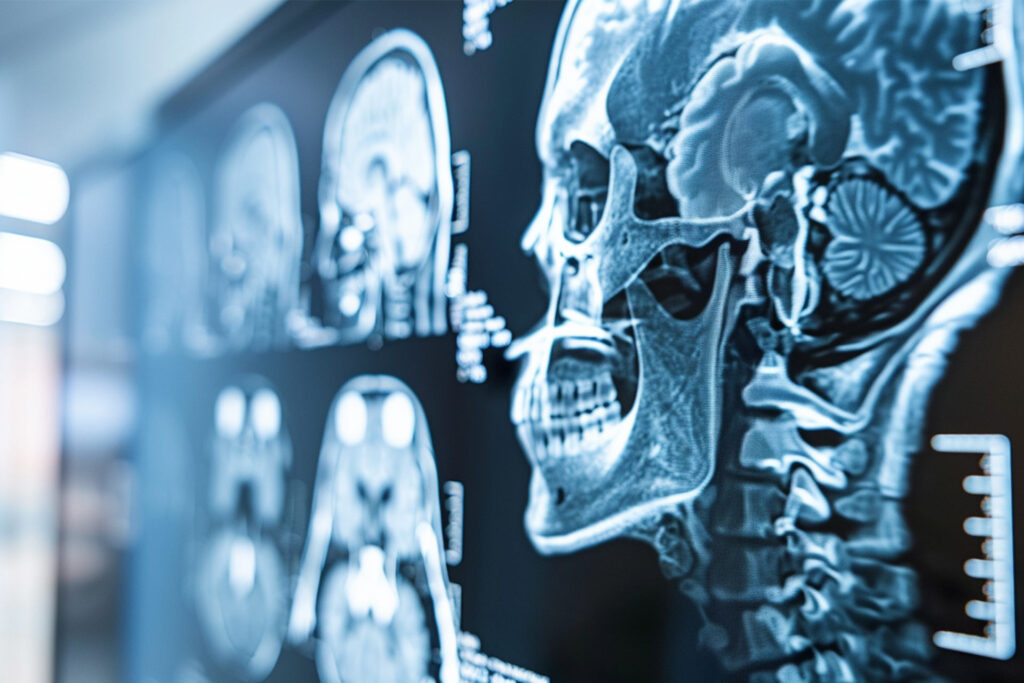
TBI predominantly damages the frontal and temporal lobes regardless of the impact mechanism (the medical foundation is covered in our companion article on blunt force head trauma), and frontal-lobe dysfunction produces four broad categories of impairment that affect relational functioning:
| Category | Functional Consequence | Spouse’s Experience |
|---|---|---|
| Executive function | Planning, organizing, prioritizing, attentional flexibility, working memory | “He can’t manage his own schedule anymore. I’m doing everything.” |
| Speed of processing | Slowed mental processing of information | Conversations stall; decisions are delayed; pace of household management collapses |
| Personality changes | Disinhibition, impulsivity, apathy, affective instability, irritability | “He says things he never would have said. He gets angry over nothing. Or he doesn’t engage at all.” |
| Empathy and social cognition | Impaired recognition of emotional cues, reduced perspective-taking, “cold” social judgment | “He doesn’t seem to notice when I’m upset. The person who used to read me instantly isn’t there anymore.” |
Quoted phrases reflect typical descriptions from spouses observing these changes; they describe neurological dysfunction, not character or intent.
A consequential clinical fact for both medical and legal purposes: the injured person often has limited self-awareness of these changes (a phenomenon called anosognosia). They may not recognize that they are being irritable, impulsive, or emotionally absent. Their values and intentions may remain intact (they may still believe themselves to be the same partner) while their neurological capacity to act in alignment with those values has become unreliable.
This is critical framing for the family and for the case. The spouse is not describing a moral failure or a character flaw. They are describing measurable neurological dysfunction that has reorganized the relationship. The consortium claim presents the relational consequences of that dysfunction.
The Nevada-Specific Consortium Framework
The TBI-specific elements that apply on top of the general loss of consortium framework are these. (Note that loss of consortium is a distinct cause of action from emotional distress claims, which follow a different legal framework.)
Who can bring the claim. Loss of consortium in Nevada is limited to spouses and registered domestic partners. NRS 122A.200 extends most spousal rights, including consortium, to registered domestic partners.
| Relationship | Consortium Claim Available? | Authority |
|---|---|---|
| Spouse | ✓ | General Electric Co. v. Bush, 88 Nev. 360 (1972) |
| Registered domestic partner | ✓ | NRS 122A.200 |
| Child for parental injury | ✗ | Bush (reversed $50K-each awards to children); reaffirmed in Heidt v. Heidt, 108 Nev. 1009 (1992) |
| Parent for adult-child injury | ✗ | Motenko v. MGM Dist., Inc., 112 Nev. 1038 (1996) |
| Surviving spouse in wrongful death | Separate framework | NRS 41.085 |
The claim is derivative. A loss of consortium claim cannot stand alone. It must be brought together with the injured spouse’s underlying personal injury claim. If the injured spouse’s claim fails, the consortium claim fails. Defenses available against the underlying claim, including the NRS 11.190 two-year statute of limitations, comparative negligence, and assumption of risk, apply equally to the consortium claim.
The settlement implication is structural. Because the consortium claim is derivative and is typically brought in the same case, a settlement of the primary personal injury claim that does not specifically carve out or value the consortium claim will release it. The spouse’s separate damages must be specifically valued and addressed in any settlement document, or the claim is gone.
What is and is not compensable:
| Compensable Under Consortium | NOT Compensable Under Consortium |
|---|---|
| Companionship | Spouse’s medical bills (those belong to injured spouse’s claim) |
| Affection | Loss of financial support (covered by injured spouse’s lost-wages claim) |
| Society | |
| Sexual relations | |
| Emotional support | |
| Services historically provided to the marriage (household management, childcare partnership) |
The exclusion of medical bills and financial support prevents double recovery between the two claims.
Damages valuation. Loss of consortium is non-economic damages, valued by the jury based on the evidence rather than by formula. Like other non-economic damages such as pain and suffering, Nevada generally places no statutory cap, though a $350,000 cap applies in medical malpractice cases under NRS 41A.035.
Factors juries typically consider:
- Duration of the marriage
- Closeness of the pre-injury relationship
- Observable changes after the injury
- Severity and permanence of the underlying injury
- Joint life expectancy of the spouses
Building the Evidentiary Record
The TBI consortium claim requires two distinct evidence streams: clinical evidence establishing the neurological injury and its functional consequences, and relational evidence establishing the actual changes the spouse and family observe. Both must be developed deliberately.
Clinical Evidence: The Neuropsychological Evaluation
A forensic neuropsychological evaluation is the central clinical document in a TBI consortium case. Forensic neuropsychology is a recognized subspecialty of clinical neuropsychology; the credentialed practitioner is a doctoral-level psychologist (PhD or PsyD) with board certification through the American Board of Professional Psychology in clinical neuropsychology and forensic experience. The evaluation produces:
- Quantified cognitive performance across attention, memory, executive function, processing speed, language, and visuospatial domains, expressed in standardized scores comparable to age-matched norms.
- Personality and emotional functioning assessment through validated instruments.
- Causation analysis linking the cognitive and behavioral findings to the index injury rather than to pre-existing conditions.
- Validity testing through embedded performance validity and symptom validity measures, which pre-empt the malingering arguments commonly raised by defense counsel.
The neuropsychological report, combined with neuroimaging where available (MRI, diffusion tensor imaging for white matter injury, functional MRI for activation patterns), establishes the medical foundation. Treating clinicians’ records (neurologist, rehabilitation physician, occupational therapist, speech-language pathologist) corroborate the functional impact.
Relational Evidence: The Spouse and Family as Witnesses
The clinical record establishes that an injury occurred and produced measurable dysfunction. The relational record establishes what the relationship has lost. This evidence comes from:
- Contemporaneous documentation by the spouse. A journal or log of specific behavioral incidents, missed family events, conversations that did not happen, decisions the partner could not participate in. Contemporaneous documentation carries more weight than reconstruction.
- Collateral informants. Pre-injury friends, employers, extended family who can describe the pre-injury person and corroborate the post-injury changes. Their testimony establishes that the changes are not the spouse’s perception alone.
- Pre-injury and post-injury comparisons. Photographs, videos, communications, employment records, financial decisions, social engagement records: anything that establishes what the person was capable of before and what the person is capable of now.
- Specific incident accounts. Detailed accounts of representative incidents (the disinhibited remark at a family event, the apathy through a child’s milestone, the inability to follow a familiar conversation) make the abstract concrete.
- The spouse’s own testimony. This is structurally challenging because it requires articulating intimate marital details, including changes in sexual relations, emotional availability, and partnership. Effective representation prepares the spouse for the discomfort of this testimony and protects against cross-examination designed to suggest the changes preceded the injury.
A Common Evidentiary Pattern
Consider a hypothetical scenario. A 45-year-old marketing executive sustains a moderate TBI in a vehicle collision. After eight months of rehabilitation, the physical injuries have largely resolved. The executive returns to work but is moved to a less demanding role; the employer documents difficulty with project planning, missed deadlines, and a pattern of inappropriate comments in client meetings. At home, the spouse describes a person who watches television in the evenings rather than engaging with the family, snaps at the children over minor issues, and no longer initiates conversation. The forensic neuropsychological evaluation documents executive dysfunction in the second percentile relative to age-matched norms, processing speed deficits, and emotional dysregulation patterns consistent with frontal-lobe injury. The pre-injury work history, family records, and friend testimony establish the prior baseline.
The consortium claim in such a pattern is supported by clinical and relational evidence that maps directly to the Nevada framework: the marriage was valid and existing at the time of the injury; the injured spouse has a meritorious primary personal injury claim; the relational losses are documented; and the causal connection from the injury to the relational loss is clinically established. This is a hypothetical example for illustrative purposes only. Actual case outcomes depend on specific facts, evidence, and circumstances.
Timeline: What to Do in the First Two Years
Statute of limitations: 2 years from the date of injury. The Nevada statute of limitations under NRS 11.190 is two years. The consortium claim’s limitation period runs with the underlying claim.
If your spouse or registered domestic partner has sustained a traumatic brain injury and you are observing the personality and functional changes described above:
- Consult with the personal injury attorney handling the underlying case about the consortium claim specifically. The consortium claim is a separate cause of action with separate damages, and it must be pleaded as part of the case. If you are not yet represented, the attorney representing the injured spouse cannot also represent you in the consortium claim because the claims are derivative but the parties are distinct.
- Begin contemporaneous documentation immediately. Specific incidents, dates, behaviors, missed family functions. Specificity carries weight; reconstruction does not.
- Identify pre-injury collateral informants while their memories are fresh. Pre-injury employers, friends, extended family who can articulate who the person was.
- Cooperate with the forensic neuropsychological evaluation. A spousal interview is typically part of the evaluation; the spouse’s observations are clinical data, not just legal evidence.
- Do not sign any settlement document for the underlying personal injury case without the consortium claim being separately valued. The derivative-claim structure means a general release of the primary claim releases the consortium claim. Settlement structure is critical.
How a Personal Injury Attorney Evaluates These Cases
TBI consortium cases require coordinated development of two evidence streams over months (the forensic neuropsychological record and the relational record) and disciplined settlement structuring to preserve the consortium claim through any resolution of the primary case. The work that determines whether the consortium claim is recognized and valued is done before the demand letter, in the deliberate development of clinical and relational documentation that connects the injury to the relational loss.
With over 40 years as a personal injury attorney, Jack Bernstein understands how complex damages claims unfold in catastrophic injury cases, including the coordination between forensic neuropsychological evidence and family witness testimony that determines whether a consortium claim is fully recognized. If your spouse or registered domestic partner has sustained a traumatic brain injury and the person you married is materially different from the person who came home, Jack Bernstein Injury Lawyers offers a free consultation to evaluate the consortium claim, the primary case posture, and the evidence development that supports both. Call (702) 633-3333.